 702461526@qq.com
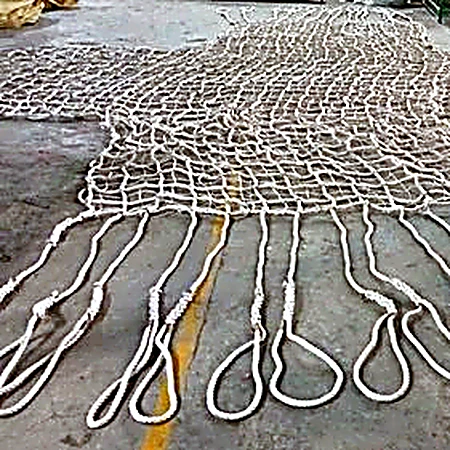
Lift sling rigging company produce Polypropylene Rope Cargo Net Sling,PP Cargo Net Sling,Polypropylene Cargo Net,Polypropylene Cargo Net Sling,High Quality Polypropylene Rope Thick Sturdy Safety Net,Cargo Lifting Mesh.
Polypropylene Rope Cargo Net Sling
A synthetic-fibre rope net sling with four lifting loops on the four corners, for general lifting purposes — made to order in Taizhou, Čína
Short description
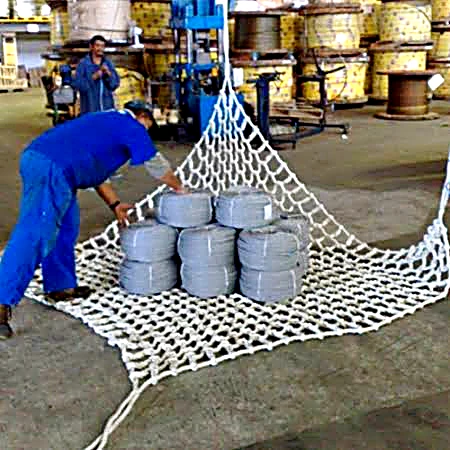
A polypropylene rope cargo net sling is a synthetic-fibre rope net made for general lifting purposes. It is made of quality propylene rope and comes with four lifting loops on the four corners, so the four loops can be gathered straight onto a crane hook, a master link or a set of shackles, and the load is carried inside the mesh.
It is the utility net of the range. Polypropylene is the most economical of the common rope fibres, it floats, it does not absorb water and it does not rot, which makes this the net that gets used on wet work, on quays, in fish and agricultural handling, and anywhere a general-purpose soft sling is wanted without the price of nylon. What it is not is an all-purpose answer: polypropylene has a real temperature ceiling, it abrades faster than nylon, and it must be ultraviolet-stabilised to survive outdoors.
We braid the rope ourselves, so diameter, pletivo, net size, border and loop length are set to your job rather than to a catalogue. Nets run from 0.5 t to 20 t with rope from 6 mm to 24 mm, every sling is load tested and supplied with a material test report, and the products carry CE and GS certification. For the nylon version see the nylon cargo lifting net, for the flat webbing version the webbing cargo lifting net, and for the whole range cargo lifting nets.

Figure 1 — A rope cargo net sling on general lifting duty: the four corner loops carry the load into the mesh and the cargo is held inside it.
1. What a polypropylene rope cargo net sling is
Four features define the product, and each one is worth understanding before you order.
- Rope, not webbing. A round rope lattice is heavier and bulkier than a flat webbing net of the same capacity, but the round strand rolls over a load rather than cutting into it, and a rope net can be repaired locally by splicing.
- Polypropylene, not nylon. PP is cheaper, lighter, immune to water and rot, and it floats. It is also more temperature-sensitive, less abrasion-resistant and stiffer in the hand — see Section 2.
- Four lifting loops, one at each corner. This is the standard configuration for a general lifting net: the four loops gather onto the hook, the net closes on the load as the crane takes up the slack, and nothing has to be choked or strapped.
- A doubled border rope. The border carries the whole load from the mesh into the loops, so it is a heavier rope than the mesh and it is spliced rather than knotted at each corner.
The net is supplied knotted or knotless, in square or diamond mesh, and in a size built to your load. Section 3 explains how the four loops actually share the load, because that is the part most buyers get wrong.
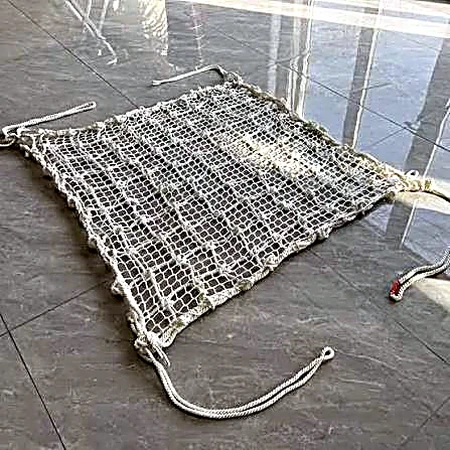
 Knotted mesh in natural white polypropylene rope — repairable on site, and easy to see through Knotted mesh in natural white polypropylene rope — repairable on site, and easy to see through |
 The same lattice in a bag form, carrying loose goods that would otherwise spread across the deck The same lattice in a bag form, carrying loose goods that would otherwise spread across the deck |
2. Why polypropylene rope
Polypropylene is the third of the common synthetic rope fibres, behind nylon and polyester. It wins on price, on water and on chemicals, and it loses on heat and on abrasion. Knowing which side of that line your job falls on is the whole decision.
| Property | Polypropylene rope | What it means in practice |
|---|---|---|
| Density | About 0.90 – 0.92 g/cm³ — below that of water | The net floats. It can be recovered if it goes over the side, and it will not sink a light load |
| Water absorption | Essentially none, below 0.1 % | No strength loss when wet, no rot, no musty smell, and it can be stored wet without harm — unlike nylon, which absorbs water and loses a little strength when soaked |
| Chemical resistance | Good against acids, alkalis and most aqueous chemicals | Suits fertilizer, agricultural chemicals and wash-down areas. Check before use with strong solvents or hot hydrocarbons |
| Ultraviolet | Degrades quickly in sunlight unless stabilised | Ultraviolet stabiliser is not an option on this net, it is a requirement. Ask for it and check that it is in the specification |
| Elongation | About 15 – 20 % at break | Less forgiving of shock than nylon, which stretches further and absorbs more energy |
| Abrasion | Lower than nylon and polyester | The rope wears where it rubs against structure and sharp edges; protection sleeves are worth having |
| Heat | Softens well below nylon and polyester | Roughly -20 °C to +80 °C working. Not for hot cargo, and keep it away from exhausts, hot slag and welding |
| Cost | The most economical of the three fibres | The right choice for utility fleets, general lifting and high-volume use |
| Handling | Stiffer and more slippery than nylon | Knots must be well dressed or spliced; a spliced eye is better than a knot at the corners |
Table 1 — What polypropylene rope gives you, and what it does not.
Rope for these nets is supplied in three polypropylene constructions, and the choice shows up in how the net feels and how long it lasts.
- Multifilament — many fine filaments twisted into the strand. The softest and most flexible of the three, and the best to handle and splice. Most general lifting nets are made in multifilament.
- Monofilament — a single extruded filament per strand. Smoother, stiffer and more resistant to surface dirt, but harsher on the hands and less forgiving over a load.
- Split-film — made from split polypropylene film tape. The most economical construction and perfectly serviceable for light duty, but with lower abrasion resistance than the other two.
The rope itself comes off the same braiding floor as our nylon ropes, and the mesh rope can be matched to the rope used in our safety rope nets where the same diameters are used.
3. The four corner loops, and how they share the load
Four loops on four corners is the configuration the product is built around, and it is also where the most common misunderstanding sits. Four loops do not give four times the capacity of one loop.

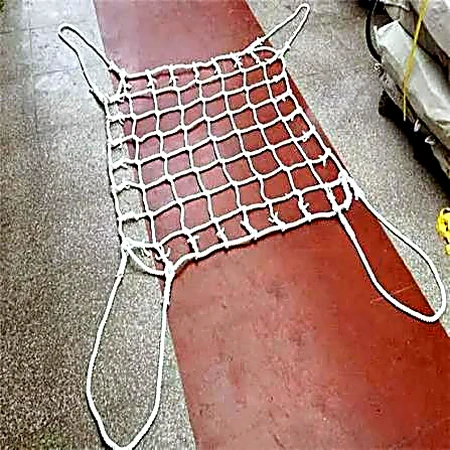
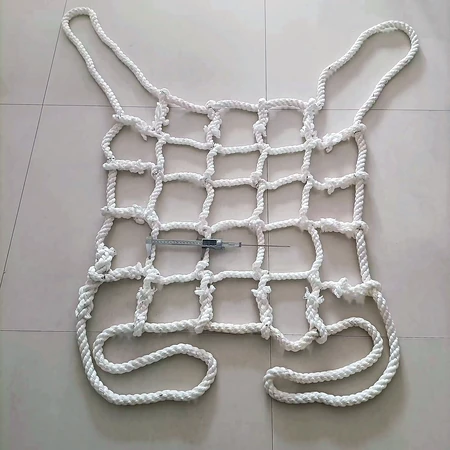
Figure 2 — Left: the four corner loops, the doubled border rope and the mesh. Right: the leg angle measured from the vertical — the wider it opens, the greater the tension in each leg for the same load.
Load share in a four-leg arrangement is rated on a three-leg basis. That is standard practice across lifting equipment, and it exists because a real load almost never sits perfectly symmetrically: one corner lifts first, one slackens, and one of the four takes more than its share. Rating the arrangement on three legs is the allowance for that.
The second factor is the leg angle. The angle is measured from the vertical, not from the deck. As the loops spread wider from the hook, the tension in each leg rises for the same load, and the arrangement carries less. A net lifted with the four loops close together under the hook behaves quite differently from the same net with the loops spread wide.
| Point to settle before ordering | Why it matters |
|---|---|
| Loops spliced or knotted | A spliced eye keeps the full rope strength; a knot reduces it. Always specify spliced for lifting duty |
| Thimble in the eye or not | A thimble protects the eye against the hook and against its own wear. Recommended for heavy or frequent use |
| Loop length | Sets how far the net drops below the hook and how steeply the legs sit — a longer loop means a wider leg angle |
| Corner reinforcement | The corner is where a rope net wears first. Doubled border rope and a reinforced corner are what make the four loops last |
| Master link or hooks | A master link gathers all four loops onto one point; four separate hooks on a beam give the load a more predictable share than four loops on one hook |
Table 2 — The four-loop decisions worth settling before you order.

Figure 3 — A rope net laid out flat: the four corner loops and the doubled border are the load path, and the mesh only contains the cargo.
4. Rope, mesh and border construction
Three decisions describe the construction of the net itself, and all three are set on the drawing.
| Decision | Options | Choose it when |
|---|---|---|
| Průměr lana | 6 mm to 24 mm; 12 mm standard | The diameter follows the load and the duty. A thicker rope lasts longer on rough work even at the same capacity |
| Mesh opening | 100 mm to 400 mm; 200 mm standard | Sized from the smallest item in the load, never from the total weight |
| Mesh orientation | Square or diamond | Diamond follows the load more closely as it settles; square is easier to measure and inspect |
| Knot or knotless | Knotted (traditional) or knotless braided | Knotted is repairable on site by splicing; knotless has no knot to wear and hangs flatter |
| Hraniční lano | Doubled rope, thicker than the mesh rope | Always — the border is the load path from the mesh into the four loops |
| Corner | Reinforced corner with a spliced eye | Always for lifting duty, and essential above 3 t |
| Loop | Spliced eye, thimble-lined eye, or a loop over a steel ring | A thimble protects the eye; a steel ring suits four loops gathering on one master point |
| Protection | Sleeve or wear pad at the contact points | Loads with sharp edges, and structure the net rubs against |
Table 3 — Rope, mesh and border options.
 Diamond mesh in polypropylene rope — the net follows an irregular load as it settles Diamond mesh in polypropylene rope — the net follows an irregular load as it settles |
 The rope lattice under load: the border takes the weight, the mesh only contains the cargo The rope lattice under load: the border takes the weight, the mesh only contains the cargo |
5. Technical parameters
The figures below cover the standard range. Průměr lana, pletivo, net size, border, loop length and capacity are all made to order, so treat this table as the starting point for a quotation rather than a fixed catalogue.
| Parametr | Specifikace |
|---|---|
| Product type | Polypropylene rope cargo net sling with four corner lifting loops |
| Rope material | 100 % polypropylene — multifilament, monofilament or split-film |
| Konstrukce lana | 3-strand laid (norma) or 8-strand braided |
| Průměr lana | 6 mm / 8 mm / 10 mm / 12 mm / 14 mm / 16 mm / 20 mm / 24 mm; 12 mm standard |
| Mesh opening | 100 mm – 400 mm, square or diamond; 200 mm standard |
| Knot | Knotted, or knotless braided |
| Border | Doubled border rope, thicker than the mesh rope, spliced at each corner |
| Lifting loops | Four corner loops standard — spliced eye, with or without a thimble |
| Loop length | 300 mm – 600 mm, nebo na objednávku |
| Čistá velikost | 1 × 1 m do 8 × 8 m, or made to drawing |
| Rated capacity | 0.5 t – 20 t, set by rope diameter, mesh and lifting arrangement |
| Rated on | A three-leg basis — the standard assumption for a four-leg arrangement |
| Safety factor | 5:1 / 6:1 / 7:1 |
| Treatment | Ultraviolet-stabilised, which is essential for polypropylene outdoors |
| Barva | Natural white, černý, orange, green, blue or a custom colour |
| Working temperature | -20 °C to +80 °C |
| Osvědčení | CE / GS / JIS; ISO 9001; CNAS laboratory; DNV |
| Customisation | OEM / ODM size, pletivo, colour, label, logo and packing |
Table 4 — Polypropylene rope cargo net sling: technical parameters.
6. Standard sizes and rated capacities
Capacity follows the rope diameter, the mesh and the lifting arrangement together. The table below gives the working range for each net size at four corner loops; heavier duty is quoted from a thicker rope rather than from a bigger net.
| Čistá velikost | Provaz Ø | Mesh | Rated capacity | Typické použití |
|---|---|---|---|---|
| 1.0 × 1.0 m | 8 mm | 100 mm | 0.5 t – 1 t | Small parts, drums, machine components |
| 1.5 × 1.5 m | 10 mm | 150 mm | 1 t – 2 t | Pallets, boxed goods, bagged material |
| 2.0 × 2.0 m | 12 mm | 200 mm | 2 t – 4 t | General lifting, bagged and loose cargo |
| 2.5 × 2.5 m | 14 mm | 200 mm | 3 t – 6 t | Timber, drums and mixed loads |
| 3.0 × 3.0 m | 16 mm | 200 mm | 5 t – 8 t | Bulk material and scrap |
| 4.0 × 4.0 m | 20 mm | 250 mm | 8 t – 12 t | Logs and large loose loads |
| 6.0 × 6.0 m | 24 mm | 300 mm | 12 t – 20 t | Quay, hold and yard work |
| Made to drawing | 6 – 24 mm | 100 – 400 mm | 0.5 t – 20 t | Any size, mesh and loop arrangement |
Table 5 — Standard net sizes and rated capacities at four corner loops.
Where the four loops gather onto a beam instead of a single hook the rating is set by the beam — see lifting spreader beam. Where the cargo is bagged or bulk and needs a closed bottom rather than an open lattice, the right product is the polyester lifting hoisting net.
7. For general lifting — and where it is not the right net
This net is sold for general lifting purposes, and general means general: mixed loads, mixed sites, mixed weather. That is exactly what polypropylene rope is good at. It is equally important to know where it stops being the right answer, because a net used outside its material limits fails quietly.
| Duty | Is this the right net? | What to use instead |
|---|---|---|
| Wet, marine, quayside and wash-down work | Yes — the best of the rope nets here | Nothing needs changing: PP floats and does not absorb water |
| Chemical and fertilizer exposure | Ano, for aqueous chemicals | Check first for strong solvents and hot hydrocarbons |
| General utility lifting of mixed cargo | Yes — the most economical rope net | Polypropylene rope, as specified |
| Hot cargo, hot slag, welding areas | No — PP softens well below nylon and polyester | No rope net; use a chain sling or a wire rope sling rated for the temperature |
| Sharp, highly abrasive loads such as scrap plate | Marginal — PP abrades faster than nylon | The heavy duty nylon cargo net sling or a wire rope net, with protection sleeves |
| Shock loading and irregular impact | Marginal — PP stretches less than nylon | The nylon cargo lifting net, which absorbs shock better |
| Maximum capacity from a thin rope | No — nylon and polyester are stronger per diameter | Nylon or polyester rope, or a flat webbing net |
| Long-term outdoor storage in strong sun | Only if ultraviolet-stabilised | Specify the stabilised rope and inspect for surface chalking |
Table 6 — Where a polypropylene rope net is the right answer, and where it is not.
If your duty falls in the right-hand column, the alternatives are on the same site: the heavy duty nylon cargo net sling, the polyester webbing net for lifting and the wire rope slings. Tell us the cargo and we will say which one fits rather than quoting the one you asked for.
8. Loop options, fittings and protection
The four loops are the working end of the product, so they are worth specifying in detail rather than leaving to default.
| Option | What it does | Choose it when |
|---|---|---|
| Spliced eye | The rope is spliced back into itself, keeping the full rope strength | Every lifting net — a knot would reduce the capacity of the loop |
| Thimble-lined eye | A steel thimble inside the eye | Heavy or daily use, and wherever the eye sits on a hook or a shackle |
| Steel ring in the loop | A ring spliced into the loop end | Four loops gathering on one master point, or a beam with four hooks |
| Longer or shorter loop | Changes how far the net drops below the hook | Deep loads need longer loops; shallow loads need shorter ones so the legs sit steeper |
| Master link | A single link that gathers all four loops | Single-point lifting under a crane hook |
| Shackle or hook | The connection between a loop and a beam | Grade 80 fittings, supplied with the beam on request |
| Protection sleeve | A sleeve over the rope at the contact point | Sharp edges, and where the net rubs against structure |
| Repair kit | Matching rope and splicing tools | Fleets that repair their own nets — a rope net can be spliced on site, which a webbing net cannot |
Table 7 — Loop options, fittings and protection.
Whatever the arrangement, the load goes into the four loops and the border — never into the middle of a panel. Lifting on fewer than the four loops, or dragging a loaded net sideways with the crane, are the two ways a rope net is destroyed in service.
9. Barva, printing and identification
A general lifting net moves between yards, trucks and sites, so it has to be identifiable wherever it ends up.
- The working load limit, the net size and the mesh are carried on a sewn capacity label, and the rope can be marked as well.
- Because the rope is dyed rather than printed, colour is the most durable identification on a rope net: natural white, černý, orange, green and blue are all standard, and a custom colour is possible on larger orders.
- The standard colour code can be applied to the label — violet 1 t, green 2 t, yellow 3 t, grey 4 t, red 5 t, brown 6 t, blue 7 t, orange 8 t — so the net can be read from across a yard.
- A contrasting border rope makes the edge and the four corners obvious, which helps at the moment of rigging and during inspection.
- OEM orders can carry your own brand, address, warning text or certificate number on the label and in the packing.
- Nets ship folded or coiled in a bag or a crate, and a rope net is bulky compared with a webbing net of the same capacity — allow for it in storage.
10. Quality control and certification
We braid the rope and make the net in the same plant, so diameter, pletivo, border and loop length are under our control rather than bought in.

Figure 4 — Our own production floor: rope and webbing coming off the machines, the same fibre used in every net on this page.
 CE attestation of conformity covering our webbing slings (EN 1492-1) CE attestation of conformity covering our webbing slings (EN 1492-1) |
 ISO 9001 quality management system certificate ISO 9001 quality management system certificate |
- 40 years of lifting equipment manufacturing — founded in 1985 in Taizhou, Jiangsu, with more than 200 employees, one of China’s largest lifting sling and net production bases.
- CE and GS certified lifting products, with JIS certification on export orders.
- Own testing laboratory — our facilities hold CNAS laboratory accreditation, European CE certification and DNV certification, with 15 authorised patents on our lifting products.
- 1000 t horizontal test machine — the breaking load of every sling is tested and documented rather than sampled, and a material test report travels with the order.
- Every net weighed, measured and marked with its working load limit, net size and mesh before packing.
11. How to specify a polypropylene rope cargo net sling
Eight pieces of information are enough for us to quote correctly the first time. The two most often left out are the lifting arrangement and the working environment, and both of them change the recommendation.
| Information we need | Why it matters |
|---|---|
| Cargo and how it is presented | Loose, bagged, palletised, bundled or irregular — it decides the mesh and the net form |
| Gross weight per lift | Sets the rope diameter and the rated capacity |
| Load dimensions and shape | Sets the net size, and whether a flat net or a bag form is right |
| Mesh opening | Sized from the smallest item in the load, never from the total weight |
| Lifting arrangement | Four loops on one hook, on a master link, or on a beam — this sets the rating |
| Loop length and type | Sets the leg angle, and whether the eye needs a thimble |
| Environment | Water, chemicals, ultraviolet exposure, temperature and abrasion — this is what decides whether polypropylene is right at all |
| Documentation and packing | Safety factor, CE / GS marking, test report, own-brand labelling and export packing |
Table 8 — What we need to quote a polypropylene rope cargo net sling.
12. Where polypropylene rope net slings are used
| Sector | What the net lifts | Why polypropylene suits it |
|---|---|---|
| Ports, quays and marine work | Loose and bagged cargo between quay, barge and vessel | It floats and does not rot — the two properties that matter most over water |
| Fishing and fish farming | Catches, cages, feed and equipment | Floats, drains, does not absorb water and does not take on odour |
| Agriculture and forestry | Bales, produce, feed, fertilizer and firewood | Chemical resistance for fertilizer, and the lowest cost of the rope fibres |
| Construction and civil work | General mixed loads, materials and debris | The economical general-purpose net for a site that handles everything |
| Waste and recycling | Loose material that would otherwise blow or fall | Contains mixed light material at a low cost per square metre |
| Logistics and warehousing | Mixed pallets and irregular loads a forklift cannot manage | One net covers a load of almost any shape |
| Public utilities and grounds work | Pipes, fittings, tools and green waste | Wet, muddy and general duty without the price of nylon |
| General lifting and hire fleets | Whatever the job brings | The utility net: one specification that covers the widest range of general lifts |
Table 9 — Where polypropylene rope cargo net slings are used.

Figure 5 — General lifting equipment at work at a port terminal, where a rope net sling is handled all day in wet conditions.
13. Care, inspection and retirement
- Inspect the four loops and their splices first, then the border, then the mesh. On a rope net the loops and the border wear before the mesh does.
- Look for cut or frayed strands, slipped or opened splices, knots that have worked loose, and rope that has flattened or gone stiff and hard.
- Check for ultraviolet damage — the rope goes dull and chalky and individual filaments crumble. On polypropylene this is a real failure mode, not a cosmetic one.
- Keep the net away from heat. Do not leave it against an exhaust, a heater or hot metal, and do not use it on hot cargo.
- Rinse a net used in salt water or with fertilizer in fresh water and dry it in the shade before storage. Polypropylene does not rot, but it does not need to carry salt or chemical residue either.
- Never exceed the rated capacity, never lift on fewer than the four loops, and never use a rope net on a load it was not specified for.
- A rope net can be repaired by splicing, but only by a competent person and only with matching rope — and the repair must be recorded. Withdraw the net from service if a splice has failed, a corner is damaged, or a whole panel of mesh is worn through.
14. Frequently asked questions
What capacity can a four-loop net sling lift?
The rated capacity on the label, for the arrangement you actually use — and it is rated on a three-leg basis even though there are four loops. Standard practice assumes the load does not sit perfectly symmetrically, so one of the four carries less or nothing. Do not multiply the capacity of one loop by four.
Does the leg angle really change the capacity?
Ano, and it is measured from the vertical, not from the deck. The wider the four legs spread from the hook, the greater the tension in each leg for the same load, so the arrangement carries less. If your loops are long and the legs spread wide, tell us — it may change the rope diameter we recommend.
Why choose polypropylene instead of nylon?
Price, water and chemicals. Polypropylene is the most economical of the rope fibres, it floats, it absorbs almost no water and it resists acids and alkalis well. Nylon is stronger for a given diameter, stretches more to absorb shock, and resists abrasion better. Choose polypropylene for wet, chemical and general utility work, and nylon for shock loads and maximum strength per diameter.
Is polypropylene suitable for outdoor use?
Ano, provided the rope is ultraviolet-stabilised, which we supply as standard for this net. Unstabilised polypropylene degrades in sunlight quickly — it goes dull and chalky and the filaments begin to crumble. Even stabilised, the net should be stored out of direct sun between jobs.
Can the net be used in the sea or in a fish farm?
It is one of the best rope nets for it. The net floats, so it can be recovered if it goes over the side, it does not absorb water so it does not get heavier or rot, and it is unaffected by salt water. Rinse it in fresh water before storage if you can.
Can I lift bags or loose material in an open net?
Small items will pass through an open lattice. For bags, choose the mesh so the smallest bag cannot squeeze through. For genuinely loose or bulk material, an open rope net is the wrong product — you want a closed-bottom net such as the polyester lifting hoisting net.
Can the net be repaired?
Ano, and this is an advantage of a rope net over a webbing net. A damaged section can be re-spliced or re-knotted with matching rope by a competent person and the repair recorded. A failed splice, a damaged corner or a whole panel worn through means the net comes out of service.
How is the capacity proved?
The net is supplied at 5:1, 6:1 or 7:1 as specified. The breaking load of every sling is tested on our own 1000 t machine and a material test report travels with the order; our products are CE and GS certified and our facilities hold CNAS, CE and DNV certification.
What else do you make for general lifting?
The same rope and webbing go into our webbing slings and kulaté závěsy, and the net range continues with the nylon flat webbing net and the cargo lifting net.
15. Why buy polypropylene rope cargo net slings from Lift

Figure 6 — Our works at Taizhou, Jiangsu: rope braiding, net making and testing under one roof.
- 40 years of lifting equipment manufacturing — founded in 1985 in Taizhou, Jiangsu, more than 200 employees, and one of China’s largest lifting sling and net production bases.
- Own rope and webbing production — diameter, pletivo, border, colour and loop length are under our control, so the net is built to your job rather than assembled from a catalogue.
- Own testing laboratory and 1000 t test machine — breaking load is tested per net and documented, with CE, GS, JIS, CNAS and DNV certification behind the products.
- Built around the four-loop configuration — spliced eyes, optional thimbles, loop length set to your leg angle, and a doubled border rope at every corner.
- One supplier for the whole lifting range — rope net slings, webbing nets, pallet nets, hoisting nets, webbing slings, kulaté závěsy, wire rope slings and lifting spreader beams.
- OEM and ODM — own-brand labelling, custom rope colours, custom sizes and export packing for distributors and fleet operators.
See the full certification set, or our export coverage below.
More from the same works: crane pallet cargo net · cargo securing net

Figure 7 — Our lifting products ship worldwide, through distributors and directly to fleets, yards and terminals.
16. Request a quotation
Send us the cargo, the gross weight per lift, the load dimensions, the mesh opening, the lifting arrangement and the environment the net will work in — or a sketch of the net you have in mind. Our engineers will confirm the rope diameter, pletivo, net size, loop length and packing, and quote it in one reply. To talk it through first, contact our engineers.
Lift Sling Rigging Company — Lifute Industrial Park, Město Taizhou, provincie JiangSu, Čína
Tel: +86 523 8693 5818 | WhatsApp: +86 180 6600 2268 | E-mail: 702461526@qq.com
HS code 630790 — lifting nets of textile materials.
Appendix A — SEO data for this page
The values below are ready to paste into the page’s SEO fields. The keyword set is drawn from rope net and four-loop language, which separates this page from the webbing and hoisting nets in the same category.
| Field | Value |
|---|---|
| Target URL | /cargo-lifting-net/polypropylene-rope-cargo-net-sling/ |
| Primary keyword | Polypropylene Rope Cargo Net Sling |
| Secondary keywords | PP rope cargo net; polypropylene cargo net sling; PP cargo net sling; polypropylene rope net sling; four loop cargo net; rope cargo net sling; polypropylene lifting net; PP rope net for lifting; synthetic rope cargo net; general purpose lifting net |
| Long-tail / scenario | polypropylene rope cargo net sling 2 ton; four loop rope net sling for crane; PP rope net sling for fish farming; polypropylene cargo net for quay work; rope net sling 3 x 3 m; multi purpose rope lifting net |
| Search intent | Commercial / transactional — the searcher is specifying a general-purpose rope net |
| SEO title (55 characters) | Polypropylene Rope Cargo Net Sling | 4-Loop Lifting Net |
| Meta description (149 characters) | Polypropylene rope cargo net sling with four lifting loops for general lifting. Thick, sturdy PP rope net, custom mesh and size, CE and GS certified. |
| H1 | Polypropylene Rope Cargo Net Sling |
| Heading chain | H1 Polypropylene Rope Cargo Net Sling → H2 per section → H3 for sub-blocks |
| Canonical | https://www.xulft.com/cargo-lifting-net/polypropylene-rope-cargo-net-sling/ |
| Sitemap priority | 0.8 (product detail page, one level below the cargo lifting net hub) |
| Word count | About 5,750 words in total — roughly 3,200 words of body copy plus 2,550 words of specification tables |
| Images on page | 13 images, every one with descriptive alt text |
| Internal links | 18 unique contextual internal links (see Appendix B) |
| Tables | 16 tables — 13 specification and data tables plus 3 image grids |
| Anchor text style | Descriptive and varied; no two anchors on the page repeat the same phrase |
Table 10 — On-page SEO reference.
Appendix B — Internal link and page-weight plan
Internal links are how a new page inherits authority. Outbound links tell Google which pages are related to this one; inbound links are what actually push weight and ranking power into this page.
B1 — Outbound contextual links from this page
| Target URL | Anchor text | Where it sits |
|---|---|---|
| /cargo-lifting-net/nylon-cargo-lifting-net/ | nylon cargo lifting net | Short description — the nylon version |
| /cargo-lifting-net/webbing-cargo-lifting-net/ | webbing cargo lifting net | Short description — the flat webbing version |
| /products/cargo-lifting-net/ | cargo lifting nets | Short description — the category hub |
| /products/nylon-rope/ | nylon ropes | Section 2 — the rope material page |
| /products/safety-rope-net/ | safety rope nets | Section 2 — matching rope diameters |
| /products/lifting-spreader-beam/ | lifting spreader beam | Section 6 — beam lifts |
| /cargo-lifting-net/polyester-lifting-hoisting-net/ | polyester lifting hoisting net | Section 6 — closed-bottom nets for bulk |
| /cargo-lifting-net/heavy-duty-nylon-cargo-net-sling/ | heavy duty nylon cargo net sling | Sections 7 and 15 — the abrasion-resistant alternative |
| /cargo-lifting-net/polyester-webbing-net-for-lifting/ | polyester webbing net for lifting | Section 7 — the material-led alternative |
| /products/wire-rope-sling/ | wire rope slings | Sections 7 and 14 — hot and sharp duty |
| /products/webbing-sling/ | webbing slings | Section 14 |
| /products/round-sling/ | kulaté závěsy | Section 14 |
| /cargo-lifting-net/nylon-flat-webbing-net/ | nylon flat webbing net | Section 14 |
| /cargo-lifting-net/cargo-lifting-net/ | cargo lifting net | Section 14 — the parent detail page |
| /certification/ | certification | Section 15 — the certificate page |
| /cargo-lifting-net/crane-pallet-cargo-net/ | crane pallet cargo net | Section 15 — the palletised version |
| /cargo-lifting-net/cargo-securing-net/ | cargo securing net | Section 15 — the tensioned restraint version |
| /contact-us/ | contact our engineers | Section 16 |
Table 11 — Outbound anchors on this page (18 unique internal links).
B2 — Inbound links to add, so this page gains weight
These are the links that build this page’s ranking power. Each one should be added to an existing, already-indexed page and should point at the polypropylene rope cargo net sling URL with the anchor shown. Vary the anchor as listed rather than repeating one phrase across every source page.
| Source page | Anchor text to use | Why this link builds weight |
|---|---|---|
| /products/cargo-lifting-net/ (hub) | polypropylene rope cargo net sling | A link from the category hub is the single strongest internal signal for a child product page |
| /cargo-lifting-net/ (section page) | PP rope cargo net | Passes section-level relevance together with the parent hub link |
| /cargo-lifting-net/cargo-lifting-net/ | four loop cargo net | The parent detail page is closely related and already indexed, so the link is worth the most in context |
| /cargo-lifting-net/nylon-cargo-lifting-net/ | polypropylene lifting net | The nylon page should point here for the wet and chemical duty where PP wins |
| /cargo-lifting-net/webbing-cargo-lifting-net/ | PP rope net for lifting | Webbing and rope nets are bought by the same general-lifting buyer |
| /products/nylon-rope/ | general purpose lifting net | The rope material page is the natural place to route rope-net buyers |
| /products/safety-rope-net/ | polypropylene cargo net sling | Same rope diameters and the same wet-duty audience |
| Homepage (products list or footer) | cargo lifting net | One homepage link to the section is enough; do not point the homepage at this page directly |
Table 12 — Inbound internal link plan.
Two rules keep the cluster healthy. First, keep these anchors distinct from each other and from the anchors used on the other net pages — repeating one phrase across many internal links is the fastest way to create keyword cannibalisation inside your own site. Second, this page should sit one click from the hub and no deeper: breadcrumb Home > Produkty > Síť pro zvedání nákladu > Polypropylene Rope Cargo Net Sling, with the breadcrumb links in the HTML rather than only in a script.
Appendix C — Google indexing and ranking checklist
| Item | What to do for this page |
|---|---|
| Indexability | Return HTTP 200, keep the page out of noindex, and make sure it is not blocked in robots.txt |
| Canonical | Self-referencing canonical to https://www.xulft.com/cargo-lifting-net/polypropylene-rope-cargo-net-sling/ |
| XML sitemap | Include the URL in the product sitemap, then resubmit the sitemap in Google Search Console |
| Internal links | Apply both tables in Appendix B. This page is currently near-empty, so inbound links are the priority |
| Title and description | Use the two values in Appendix A; the page currently has neither a unique title nor a description |
| Heading structure | One H1, then H2 per section, then H3 for sub-blocks — never skip a level |
| Image SEO | Descriptive alt text on all 13 images, file names in lower case with hyphens, WebP format, and lazy loading below the fold |
| Structured data | Add Product JSON-LD with name, image, description, brand and manufacturer, plus BreadcrumbList for the breadcrumb path and Organization at site level |
| Core Web Vitals | Compress images to WebP, set width and height on every image to avoid layout shift, and defer non-critical scripts |
| Page is currently empty | The live page carries a short product-name list only, with no datasheet, no gallery and no technical content. Everything in this document is new copy; replace the placeholder text rather than appending to it |
| Existing content to keep | The five product bullets and the short description already on the page — fully customizable safety ratio / length / colour, premium materials, wear and high-temperature resistance, soft flexible lightweight with no harm to cargo, and CE and GS certification. The high-temperature claim should be reviewed, because polypropylene has a real temperature ceiling (see Section 2) |
| Search Console | Submit the URL for indexing, then check the Page Indexing and Core Web Vitals reports a week later |
| Rank tracking | Track the primary keyword plus the three main secondary keywords weekly against the nylon cargo lifting net page and the top three competitors |
Table 13 — Google indexing and ranking checklist.