 702461526
Lift sling rigging company produce nylon rope cargo net, steel wire rope cargo net and high-strength webbing cargo net.
Cargo Lifting Net
Nylon rope, steel wire rope and high-strength webbing woven cargo lifting nets
Rated 1 t to 100 t | Mesh, size and lifting points to your drawing | Every net breaking-load tested
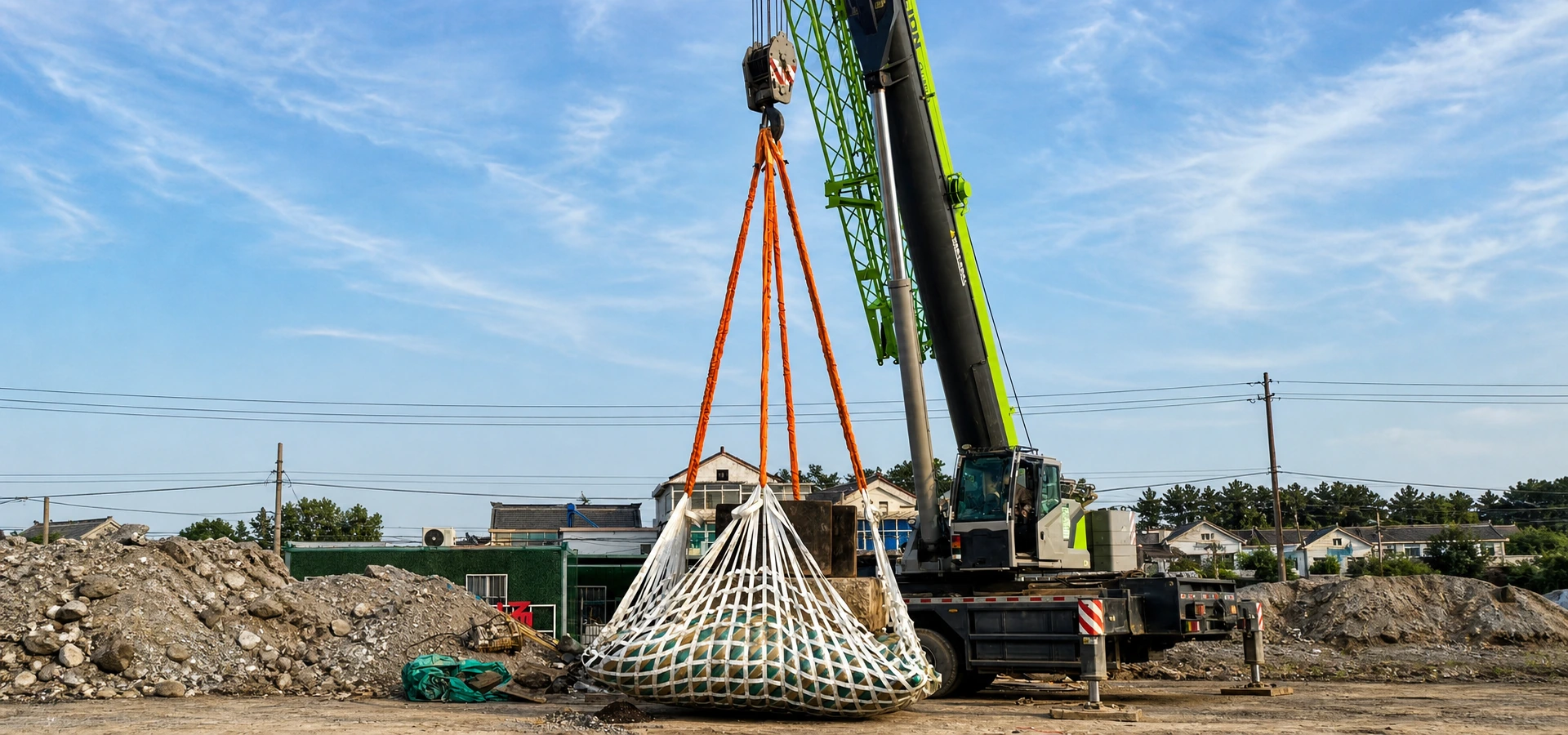
Figure 1 — A rope cargo lifting net in service: the corner loops are gathered onto the crane hook and the whole consignment is carried inside the net instead of on top of it.
Short description
A cargo lifting net lifts a whole consignment as one unit. Hung from its corner or multi-point slings, it spreads the load across a wide face instead of a single point, so irregular, loose or stacked goods can be moved without being repacked or strapped one piece at a time. The soft, wide bearing face is what separates a net from a chain or a wire rope sling: nothing sharp touches the cargo, and no part of the load is left hanging outside the lift.
Lift Sling Rigging Company manufactures cargo lifting nets in three woven constructions — nylon rope, steel wire rope and high-strength webbing — covering a rated capacity of 1 t to 100 t, with mesh opening, net size, border and lifting points built to your drawing. Every net is proof-load tested on our own equipment and supplied with a capacity label and a material test report.
Tell us the load, its shape and how it is presented to the crane, and we will confirm the net that fits it — including the mesh that keeps the cargo inside and the lifting points that keep the net square under load.
1. Product overview
A cargo lifting net is a woven lattice, not a bag and not a sling. Bands or strands cross at right angles to form an open mesh; the four sides and corners take the load; and the cargo sits inside the mesh rather than on top of it. Four elements decide how the net performs:
- The strand or the band — nylon rope, steel wire rope or flat high-strength webbing. It sets the strength, the weight of the net, the surface contact and the resistance to abrasion and heat.
- The mesh opening — the size of the square or diamond hole. It decides what stays inside the net and how much the net weighs, and it is chosen from the smallest dimension of the cargo, never from the outside size of the net.
- The border — a doubled or reinforced edge that runs all the way round, so the edge bands cannot unroll, spread or pull out under load.
- The lifting points — four reinforced corner loops as standard, or eight points where the net is lifted from a spreader beam. Load goes into the corners and the border, never into the middle of a panel.
Because a net carries a consignment over a wide area rather than at a few contact points, the pressure at each point drops. That is why a net is chosen for cargo that cannot be repacked — bagged goods, loose stone, logs, drums, tyres, scrap, coils and bundled sections — and for any load whose outer surface must not be marked.
The three woven constructions
We weave the same lattice three ways. The construction is chosen from the cargo, the environment and the lifting method, not from the price alone.
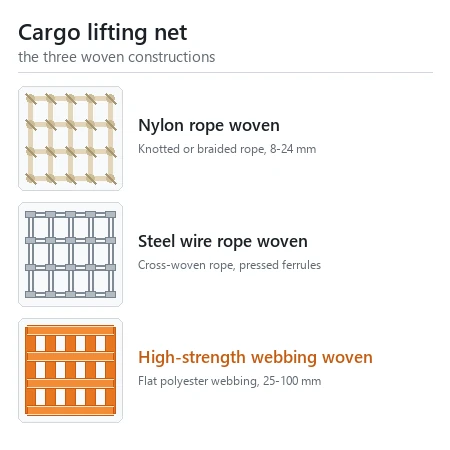
Figure 2 — The three woven constructions: knotted or braided nylon rope, cross-woven steel wire rope with pressed ferrules, and flat high-strength webbing woven into a square mesh.
2. Nylon rope woven cargo lifting net
A nylon rope cargo lifting net is a knotted or braided net made from high-tenacity nylon (polyamide) rope. Rope is the oldest and the most forgiving net construction: each strand can move slightly inside the knot or splice, so the net settles around an irregular load instead of sitting on top of it, and nylon’s high elongation absorbs the shock when the crane takes up the slack. Rope nets are the usual choice for timber and logs, stone, scrap, drums, tyres, and for any load whose shape shifts as it is lifted.
Because the strands are round and the mesh is open, water drains straight through the net. That is why rope nets are widely used on deck and at the quayside, where a wet net has to be folded, stowed and used again the same day.
Palletised and bagged cargo is more usually carried by a flat net — see the webbing cargo lifting net — while stone, rubber and demolition loads are served by the heavy duty nylon cargo net sling.
Construction
- Rope — 100% high-tenacity nylon multifilament, 3-strand laid or 8 / 12-strand braided.
- Knot — knotted with a netmaker’s knot, or knotless braided splice where a flatter mesh is wanted.
- Border — doubled border rope, spliced into the four corners so the load path is continuous.
- Lifting points — four corner eyes as standard; eight points for a spreader beam or a multi-leg lift.
- Finish — optional PU or PVC coating and UV stabiliser for long outdoor service.
| Parameter | Specification |
|---|---|
| Material | 100% high-tenacity nylon (polyamide) multifilament |
| Rope construction | 3-strand laid, or 8-strand / 12-strand braided |
| Rope diameter | 8 mm – 24 mm standard; up to 32 mm on request |
| Mesh opening | 100 mm – 300 mm, square or diamond |
| Knot type | Knotted, or knotless braided |
| Border | Doubled border rope with spliced corners |
| Lifting points | 4 corner eyes standard; 8-point on request |
| Rated capacity | 1 t – 50 t; heavier nets built to order |
| Safety factor | 5:1 / 6:1 / 7:1 |
| Elongation at break | approx. 18 – 22 % — absorbs shock load |
| Coating / treatment | UV-stabilised; optional PU or PVC coating |
| Working temperature | -40 °C to +80 °C |
| Standard / marking | Built to your nominated standard, with WLL tag and material test report |
| Certification | CE, GS, ISO 9001; test report with each order |
Table 1 — Nylon rope woven cargo lifting net: technical parameters.
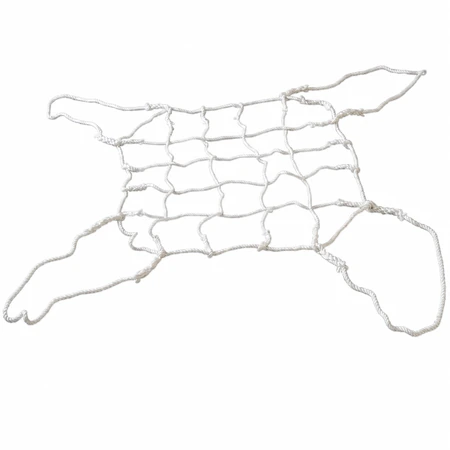
Knotted nylon rope net laid flat — square mesh, doubled border rope. |
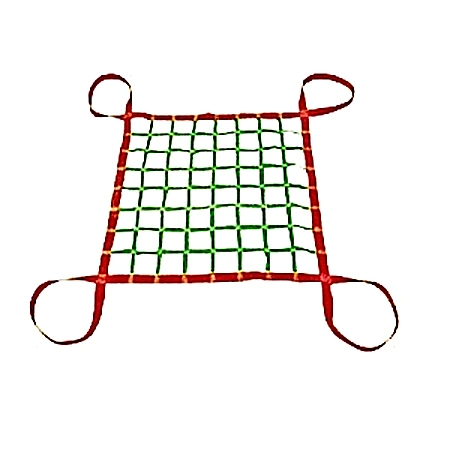
Rope net in closed bag form, with four corner eyes gathered for a single-hook lift. |
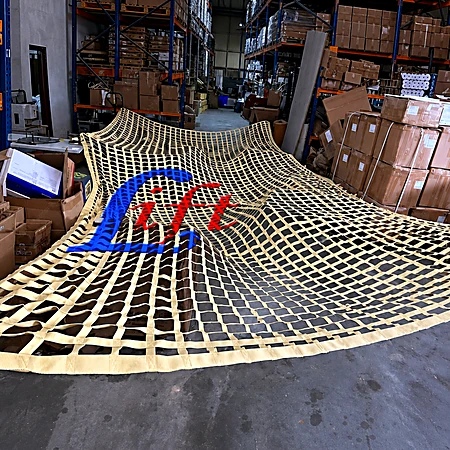
Large rope net suspended from its corners; the mesh stays open and drains freely. |
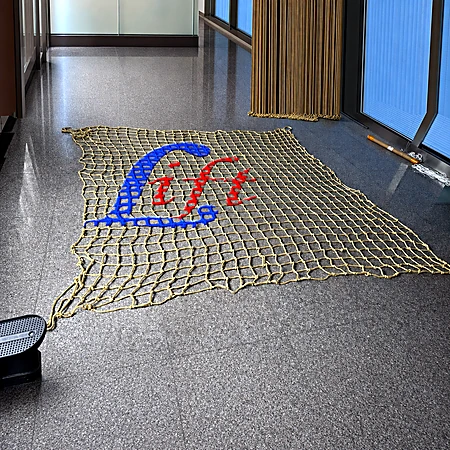
Diamond mesh under load — the strands rotate inside the knots and settle around the cargo. |
3. Steel wire rope woven cargo lifting net
A steel wire rope cargo lifting net is cross-woven from galvanised steel wire rope. The ropes pass over and under each other and are locked at every intersection with pressed aluminium ferrules, so the mesh cannot open up or distort as the net is dragged across a quay or a truck bed. Wire rope is the construction to choose when the net has to survive abrasion, sharp edges, hot surfaces or a long service life with little maintenance.
It is the heaviest of the three constructions and the least forgiving to finished surfaces, so it is normally specified for bulk and rough cargo — stone, ore, aggregates, scrap, demolition debris, and for hot or dirty environments where a textile net would be consumed quickly. Where the cargo must not be marked, the net is supplied with a sheathed or sleeved version of the same construction, built from the same rope as our wire rope slings.
Construction
- Rope — galvanised steel wire rope, 6×19 for abrasion resistance, 6×37 / 6×36WS for flexibility; fibre core or independent wire rope core (IWRC).
- Mesh lock — pressed aluminium ferrules at every intersection, formed on our own press.
- Border — border rope running continuously round the net, ferrule-locked to the mesh.
- Lifting points — pressed eyes with thimbles at the corners, or corner rings / master links.
- Surface — hot-dip galvanised as standard; stainless steel 304 / 316 on request for marine and chemical service.
| Parameter | Specification |
|---|---|
| Material | Galvanised steel wire rope; stainless 304 / 316 on request |
| Rope construction | 6×19 — abrasion resistance; 6×37 / 6×36WS — flexibility |
| Core | Fibre core (FC) or independent wire rope core (IWRC) |
| Rope diameter | 6 mm – 20 mm standard; larger on request |
| Mesh opening | 150 mm – 400 mm, square |
| Mesh lock | Pressed aluminium ferrules at every intersection |
| Border | Continuous border rope, ferrule-locked to the mesh |
| Lifting points | Pressed corner eyes with thimbles, or corner rings / master links |
| Rated capacity | 2 t – 100 t; heavier nets built to order |
| Safety factor | 4:1 / 5:1 / 6:1 |
| Elongation | Very low — the mesh keeps its shape under steady load |
| Abrasion / cut | Highest of the three constructions |
| Working temperature | Suitable for hot and dirty service; confirm the duty with us |
| Standard / marking | Built to your nominated standard, with WLL tag and test certificate |
| Certification | CE, ISO 9001; facility holds CNAS and DNV certification |
Table 2 — Steel wire rope woven cargo lifting net: technical parameters.
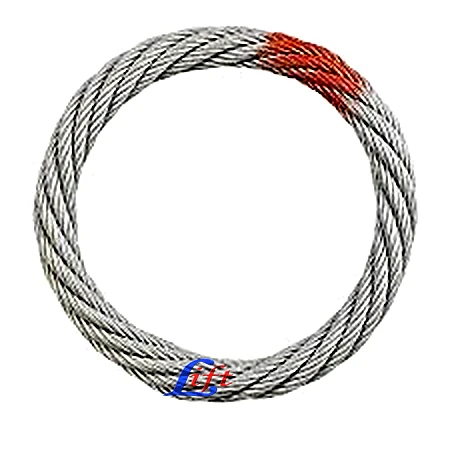
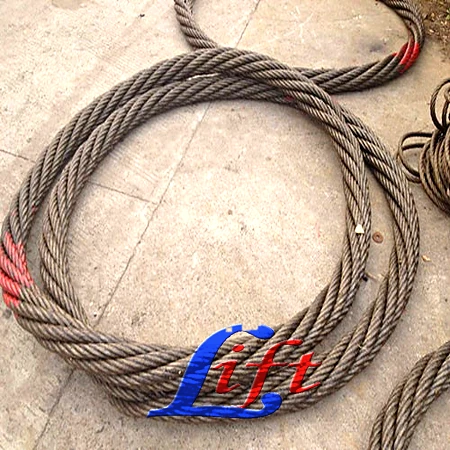 Galvanised steel wire rope — the rope is woven into the mesh and locked at every crossing. |
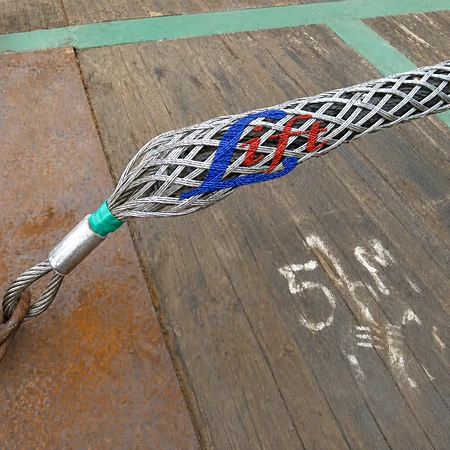 Braided wire mesh sleeve, the same over-and-under braid used across the net. |
 Pressed wire rope corner eye with a galvanised thimble — one of the net’s lifting points. |
4. High-strength webbing woven cargo lifting net
A high-strength webbing cargo lifting net is woven from flat polyester webbing instead of rope. The bands cross at right angles to form an open square mesh, the four sides and corners take the load, and the whole net is soft enough to sit against bagged, boxed, painted or machined cargo without marking it. It carries the widest bearing face of the three constructions at the lowest net weight, which is why it is the standard choice for palletised, bagged and unitised cargo on cranes, in ports and on trucks.
Polyester has low elongation, so the net does not stretch away from the cargo while the crane takes up the slack — the mesh keeps its shape and the load stays square. The webbing is woven in our own mill, so band width, colour, mesh and capacity are under our control and a net can be tuned to the load instead of being bought in from a catalogue.
It is the same high-tenacity polyester webbing used in our webbing slings and endless round slings, so the net and the sling on the same lift are matched in elongation and in colour coding.
Construction
- Webbing — 100% high-tenacity polyester, 50 mm wide as standard; 25 mm, 75 mm and 100 mm on request. Nylon or polypropylene webbing available.
- Mesh — 100 × 100 mm square as standard — small enough to hold bags, bricks, boxes and small components, open enough to keep the net light.
- Border — double-layer stitched border around the whole net, so the edge bands cannot unroll or pull out.
- Lifting points — four reinforced corner loops stitched through the border, or additional loops and rings for a spreader beam.
- Treatment — UV-resistant, anti-aging, wear and tear resistant; colour-coded to the working load limit on request.
| Parameter | Specification |
|---|---|
| Material | 100% high-tenacity polyester webbing; nylon or polypropylene on request |
| Webbing width | 50 mm standard; 25 mm / 75 mm / 100 mm on request |
| Mesh opening | 100 × 100 mm square standard; 50 mm – 300 mm on request |
| Rated capacity | 1 t – 100 t; heavier loads built to order |
| Safety factor | 5:1 / 6:1 / 7:1 |
| Elongation | Low — approx. 7 % at the working load limit |
| Border / corners | Double-layer reinforced stitched border; four reinforced corner loops |
| Lifting points | 4 corner loops standard; 8-point and ring fittings on request |
| Colour | Orange (high visibility) / blue / black / green / custom colour |
| Treatment | UV-resistant, anti-aging, wear and tear resistant |
| Working temperature | -40 °C to +100 °C (polyester webbing) |
| Standard / marking | Built to your nominated standard; capacity label and material test report |
| Certification | CE, GS, ISO 9001 |
| Customisation | OEM / ODM size, label, logo, printed webbing and colour |
Table 3 — High-strength webbing woven cargo lifting net: technical parameters.
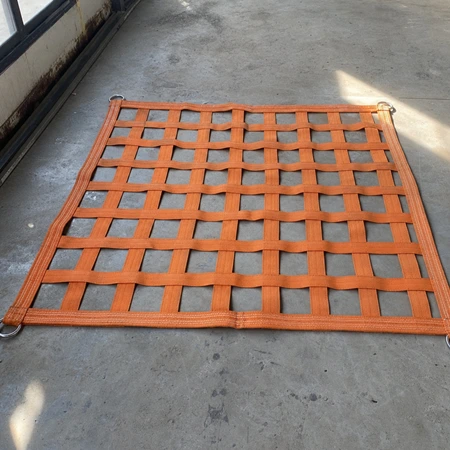
Webbing net laid out flat — 50 mm orange polyester bands woven into a 100 mm square mesh. |
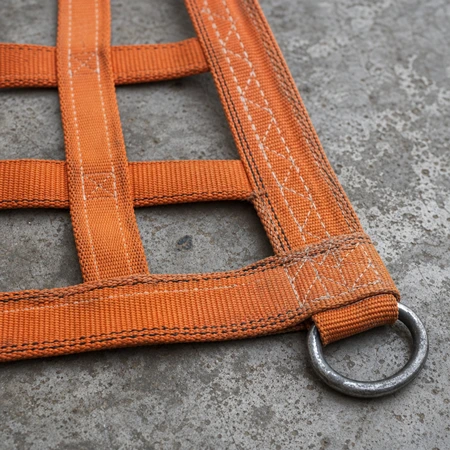
Corner detail — double-layer stitched border, reinforced corner loop and mesh between the bands. |
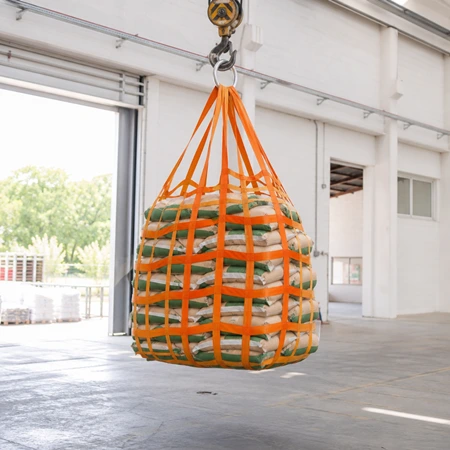
Webbing net in bag form lifting a stack of bagged goods from a single crane hook. |
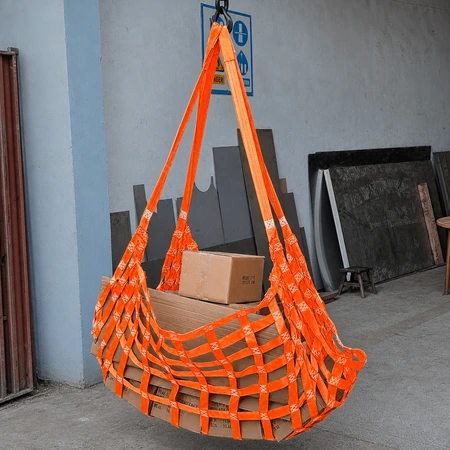
Closed three-dimensional net carrying boxed and palletised cargo without marking it. |
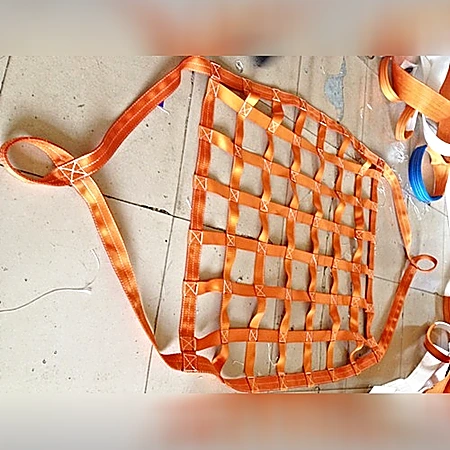
Net bag with corner straps laid out — the four lifting points take the whole load. |
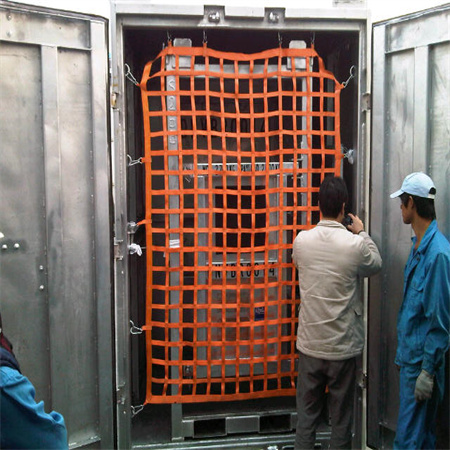 Webbing net fitted as a securing net across a container doorway. |
5. Which weave for which job
The three constructions overlap in capacity, so the decision is usually made by the cargo and the environment rather than by tonnage. The table below is the short version of the advice we give on a quotation.
| Characteristic | Nylon rope woven | Steel wire rope woven | High-strength webbing woven |
|---|---|---|---|
| Surface contact | Round strands, soft; will not scratch | Hard wire; can mark and dent soft packaging | Flat bands, widest soft face; non-marking |
| Net weight | Moderate; drapes easily | Heaviest; needs two people and lifting gear | Lightest; one person can fold it into a bag |
| Corrosion | Rot-proof; good in wet and salt water | Galvanised or stainless rope needed | Rust-free polyester; UV-treated |
| Abrasion and cut | Good; a damaged strand can be replaced locally | Highest of the three | Good, but must be kept off sharp edges |
| Elongation | High, 18 – 22 % — absorbs shock | Very low | Low, approx. 7 % at WLL — stable |
| Typical capacity | 1 t – 50 t | 2 t – 100 t | 1 t – 100 t |
| Repairability | Local re-knot or splice, then re-inspect | Re-ferrule or replace the damaged rope | Stitched repair or replacement of the corner loop |
| Best for | Timber, logs, stone, scrap, drums, tyres, wet deck work | Hot, sharp, abrasive bulk; long service life; rough handling | Bagged, boxed, palletised, painted and machined cargo; ports and trucks |
Table 4 — Choosing the net for the job.
Where a load is both rough and finished — for example plated components in a stillage — the answer is usually a webbing net with edge protection, or a wire rope net fitted with a sheathed contact section. Tell us on the enquiry that the cargo is dressed and we will choose the mesh and the edge protection with that in mind.
6. Standard net sizes and rated capacities
Sizes below are our standard range; anything else is made to drawing, including truck bed, container, hold and spreader dimensions. The capacity that applies is the capacity of the net as it is rigged, not the capacity of the crane.
| Net size (L × W) | Typical capacity | Typical use |
|---|---|---|
| 2.0 × 2.0 m | 1 t – 3 t | Drums, machine parts, small components |
| 2.5 × 2.5 m | 2 t – 5 t | Palletised and bagged cargo, container loading |
| 2.5 × 6.0 m | 4 t – 10 t | Long cargo, pipe bundles, truck and trailer loading |
| 4 × 4 ft (1.2 × 1.2 m) | 2 t – 3 t | Small loads, drums, machine parts (imperial markets) |
| 82 × 82 in | 2 t – 5 t | Standard pallet footprint in imperial markets |
| 6.0 × 6.0 m | 10 t – 25 t | Bulk bagged cargo, timber, scrap |
| 8.0 × 8.0 m | 25 t – 50 t | Heavy bulk, stone, quarry and demolition work |
| Built to drawing | 1 t – 100 t | Truck bed, container, hold and spreader beam dimensions |
Table 5 — Standard net sizes. Custom sizes, mesh and lifting points are made to drawing.
The common pallet footprints are covered by the crane pallet cargo net and the nylon flat webbing net; long consignments and container work are usually served by a polyester lifting hoisting net or a cargo securing net.
Every net is marked with its working load limit and with the identification it was made to. Where a net is used in more than one configuration, each configuration is listed separately on the label, because the rating is different for a four-point lift and a two-point choke.
7. What we need to quote a cargo lifting net
| Information | Why it matters |
|---|---|
| Load weight and load shape | Sets the rated capacity and the number of load-bearing strands or bands under the cargo |
| Net length × width | The net must be larger than the load footprint so the cargo sits inside the mesh |
| Mesh opening | 100 × 100 mm is the usual standard; a smaller mesh is needed for small or loose items |
| Strand / band width and colour | Rope diameter or webbing width sets the strength; colour is used for identification and high-visibility sites |
| Lifting points | Four corner loops as standard, or additional loops and rings for a spreader beam |
| Crane, hook or spreader | Determines the ring, shackle or thimble fitted to the corner loops |
| Environment | UV, salt water, offshore or high-temperature duty decides the material and the treatment |
| Documentation | Tell us if you need CE marking, a test report, a declaration of conformity or own-brand labels |
Table 6 — The eight questions behind every net quotation.
8. How a cargo lifting net is rigged
- Four-point lift from a single hook — the standard arrangement. The four corner loops are gathered onto the hook or a master ring, so the net closes around the cargo as it takes up.
- Spreader beam lift — eight lifting points on a beam or frame. The net stays square and the load stays level, which is what a long or wide consignment needs.
- Bag form — a closed three-dimensional net for loose goods that must not escape, such as bricks, split stone, bottles or small castings.
- Flat net with the cargo sitting inside the mesh — for palletised, bundled or unitised loads that only have to be held together.
Long or wide consignments are usually lifted from a beam rather than a single hook — the lifting spreader beam takes the eight points, keeps the net square and keeps the cargo level while it is transferred.
Whatever the arrangement, the load goes into the corners and the border. Loading the middle of a panel, dragging the net sideways with the crane, or lifting on fewer than the full set of lifting points are the three ways a net is destroyed in service.
9. Colour, marking and identification
- Orange is the high-visibility standard colour for lifting nets and is the easiest to see on a quay or in a container.
- Blue, black, green and custom colours are available for fleet identification or to match existing equipment.
- Each net is supplied with a capacity label; own-brand labels, printed webbing and instruction text can be stitched in on OEM orders.
- Nets can be packed in a bag or a crate, or supplied with a repair kit and a spare corner loop where the customer maintains their own fleet.
10. Quality control and certification
Lift Sling Rigging Company was founded in 1985 in Taizhou, Jiangsu, and has been manufacturing lifting equipment for 40 years. Cargo nets are produced in the same plant as our webbing slings, round slings and wire rope slings, on the same quality system.
- Own testing laboratory, CNAS, CE and DNV certified, with a 1000 t horizontal test machine.
- Breaking load tested per net, with the result documented in the material test report supplied with the order.
- 15 authorised patents and participation in the drafting of industry standards.
- Weave, stitching and ferrule pressing are controlled in house, so the net that is quoted is the net that is delivered.
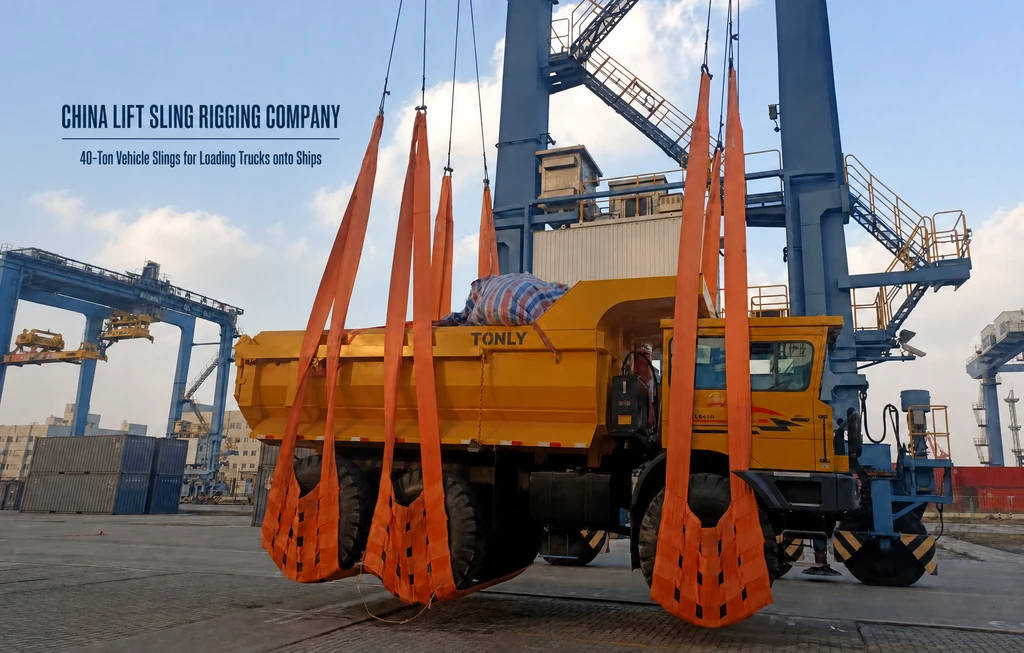
Figure 3 — Wide, soft-contact slings and nets are used where a chain or a wire rope would concentrate the load: here a 40-t vehicle sling loads a dump truck onto a ship at a port terminal.
11. Using and inspecting a cargo lifting net
- Read the capacity label before every lift and check that the load weight is inside the rated capacity for the way the net is actually rigged.
- Inspect the strands or bands for cuts, abrasion, chemical staining, heat damage, broken stitching and UV degradation.
- Check the corner loops, the corner ferrules and their stitching most carefully — this is where a net wears first.
- Load the net evenly, keep the cargo inside the mesh and away from the border, and protect the load-bearing members from sharp edges and hot surfaces with a sleeve or pad.
- Never exceed the rated capacity, never lift on fewer than the full set of lifting points, and never use the net to drag a load sideways.
- Store the net clean and dry, off the ground and out of direct sun. Never repair a net by knotting a broken strand, welding a wire rope or heating a band.
- Withdraw the net from service if any load-bearing strand or band, the border or a corner loop is damaged, and have it inspected by a competent person at the interval your site requires.
12. Applications
| Sector | What the net does |
|---|---|
| Ports and terminals | Container stuffing and de-stuffing, palletised and bagged cargo, quay and hold work where the net must be soft, rust-free and easy to fold |
| Steel and fabrication | Bundles, plate packs, machined parts and stillage loads where the surface must not be marked |
| Stone, quarry and aggregates | Split stone, blocks, cobbles and abrasive bulk; flattened steel or heavy square mesh where cut resistance matters |
| Timber and forest products | Logs, sawn packs and poles — rope nets settle around an irregular stack as it is lifted |
| Offshore and marine | Cargo transfer on deck and over the side; nylon and polyester constructions drain and do not rust |
| Agriculture and bulk bags | Fertiliser, grain, seed and feed in bags and big bags, lifted whole |
| Recycling and scrap | Mixed and abrasive scrap, where a wire rope net outlasts a textile one |
| Military and disaster relief | Cargo lifted by crane or helicopter and then folded away for transport |
| Vehicle and machinery loading | RoRo and breakbulk loading of trucks, buses and plant, where a wide net spreads the load over the body and chassis |
Table 7 — Where cargo lifting nets are used.
Two neighbouring ranges are often quoted together with a net: vehicle lifting net for RoRo and breakbulk vehicle loading, and safety rope nets — or the Kevlar braided aramid rope net — where the net is protecting people rather than holding cargo. Tell us which duty applies and we will confirm the right construction.
13. Frequently asked questions
What working load should I specify?
The load as it is presented, for the arrangement you will actually use. A net’s rating is not the same as the crane’s, and a four-point lift and a two-point choke give different ratings for the same net.
Which of the three weaves should I choose?
Send us the cargo and the environment. Rough, hot or abrasive bulk points to steel wire rope; cargo that must not be marked points to webbing; irregular loads that have to settle into the net, and wet deck work, point to nylon rope.
Can a net be made to my size?
Yes. Size, mesh, strand or band width, number of lifting points, colour and capacity are all made to order, including truck bed, container, hold and spreader dimensions.
What mesh opening should I use?
The mesh is chosen from the smallest dimension of the cargo, not from the size of the net. 100 × 100 mm webbing mesh is our standard; loose or small items need a smaller opening.
Can a net lift bags, bricks or loose cargo?
Yes — that is what the closed three-dimensional bag form is for. Where the goods must not escape the net at all, specify the bag form rather than a flat net.
Is a net suitable for marine or offshore use?
Yes. Polyester and nylon nets are UV-treated and rust-free, wire rope nets can be supplied galvanised or in stainless steel, and all three drain freely on deck.
Do you supply the net with a test certificate?
Yes. Each net is supplied with a capacity label and a material test report, and our facility holds CNAS, CE and ISO 9001 certification. Own-brand labels and printed markings are available on OEM orders.
What is the minimum order quantity?
There is no fixed minimum for standard constructions — one net for a trial, batch quantities for production. Mixed sizes and mixed constructions can be combined in one order.
How is the net packed for export?
Folded and strapped with the label and certificate attached, then bag or crate packed as agreed, with export packing built to survive sea freight.
14. Why buy cargo lifting nets from Lift
- 40 years of lifting equipment manufacturing — founded in 1985 in Taizhou, Jiangsu, more than 200 employees, and one of China’s largest lifting sling and net production bases.
- We weave our own webbing and make our own rope nets — width, colour, mesh and capacity are under our control, so a net can be tuned to the load instead of bought in from a catalogue.
- Own testing laboratory and a 1000 t test machine — breaking load is tested per net and documented, and our facilities hold CNAS, CE and DNV certification.
- One supplier for the whole cargo range — cargo lifting nets, webbing slings, round slings, wire rope slings, lifting spreader beams, nylon ropes, safety rope nets and vehicle lifting nets.
- OEM and ODM — own-brand labels, printed webbing, custom colours and export packing for distributors and end users.
More from the same works: nylon ropes · cable pulling socks
15. Request a cargo lifting net quotation
Send us the load weight and shape, the net size, the mesh opening, the lifting points you need and the environment the net will work in — or a drawing of the truck bed, container or hold it has to fit. Our engineers will confirm the construction, the rated capacity, the strand or band width and the packing, and quote the net in one reply. To talk it through first, contact our engineers and we will come back with the recommended net rather than a price list.
| Lift Sling Rigging Company Lifute Industrial Park, Taizhou City, Jiangsu Province, China Tel: +86 523 8693 5818 | WhatsApp: +86 180 6600 2268 | E-mail: 702461526@qq.com HS code: 630790 |
|---|
Appendix — SEO data for this page
Reference information for whoever publishes the page. Keyword data is written for the target URL below.
| Item | Value |
|---|---|
| Target URL | https://www.xulft.com/cargo-lifting-net/cargo-lifting-net/ |
| Primary keyword | Cargo Lifting Net |
| Secondary keywords | cargo net; lifting net; webbing cargo net; nylon cargo net; wire rope cargo net; heavy duty cargo lifting net; cargo lifting net manufacturer; cargo net sling |
| SEO title (51 characters) | Cargo Lifting Net | Nylon, Wire Rope & Webbing Nets |
| Meta description (146 characters) | Cargo lifting nets in nylon rope, steel wire rope and high-strength webbing. 1-100 t capacity, custom mesh and size, CE and ISO 9001. Get a quote. |
| H1 | Cargo Lifting Net |
| H2 outline | Product overview / Nylon rope woven cargo lifting net / Steel wire rope woven cargo lifting net / High-strength webbing woven cargo lifting net / Which weave for which job / Standard net sizes and rated capacities / What we need to quote / How a net is rigged / Colour, marking and identification / Quality control and certification / Using and inspecting / Applications / FAQ / Why buy from Lift / Request a quotation |
| Anchor text style | Descriptive, keyword-bearing and varied. No two anchors on the page repeat the same phrase, and no anchor is a bare “click here” or “read more”. |
| Internal anchors | 17 contextual internal links, listed in Table 9 |
Table 8 — On-page SEO reference.
| Target URL | Anchor text | Where it sits |
|---|---|---|
| /products/cargo-lifting-net/ | cargo lifting net range | Short description, paragraph 2 |
| /cargo-lifting-net/webbing-cargo-lifting-net/ | webbing cargo lifting net | Section 2, after the rope-net paragraph |
| /cargo-lifting-net/heavy-duty-nylon-cargo-net-sling/ | heavy duty nylon cargo net sling | Section 2, same sentence |
| /products/wire-rope-sling/ | wire rope slings | Section 3, closing sentence |
| /webbing-sling/ | webbing slings | Section 4, webbing paragraph |
| /round-sling/endless-round-sling/ | endless round slings | Section 4, same sentence |
| /cargo-lifting-net/crane-pallet-cargo-net/ | crane pallet cargo net | Section 6, below the size table |
| /cargo-lifting-net/nylon-flat-webbing-net/ | nylon flat webbing net | Section 6, same sentence |
| /cargo-lifting-net/polyester-lifting-hoisting-net/ | polyester lifting hoisting net | Section 6, same sentence |
| /cargo-lifting-net/cargo-securing-net/ | cargo securing net | Section 6, same sentence |
| /products/lifting-spreader-beam/ | lifting spreader beam | Section 8, before the closing paragraph |
| /vehicle-lifting-net/ | vehicle lifting net | Section 12, below the applications table |
| /safety-rope-net/aramid-fall-protection-safety-net/ | safety rope nets | Section 12, same sentence |
| /safety-rope-net/kevlar-braided-aramid-rope-net/ | Kevlar braided aramid rope net | Section 12, same sentence |
| /products/nylon-rope/ | nylon ropes | Section 14, “More from the same works” |
| /wire-rope-sling/cable-pulling-socks-grip/ | cable pulling socks | Section 14, same line |
| /contact-us/ | contact our engineers | Section 15, closing sentence |
Table 9 — Internal link and anchor-text plan. All URLs are on www.xulft.com and resolve to pages that already exist on the live site.
Suggested image alt text: “Cargo lifting net in service lifting stone blocks by crane”, “Nylon rope woven cargo lifting net, knotted mesh and doubled border”, “Steel wire rope woven cargo lifting net with pressed ferrules”, “High-strength webbing woven cargo lifting net, 50 mm polyester bands and 100 mm mesh”, “Webbing cargo lifting net corner detail with reinforced corner loop”.