

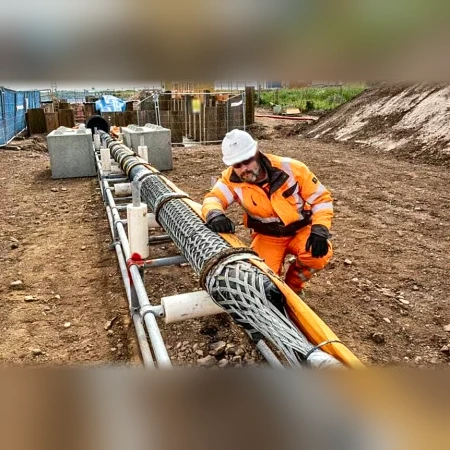
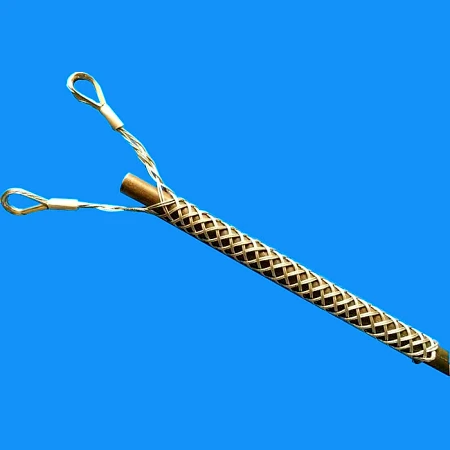
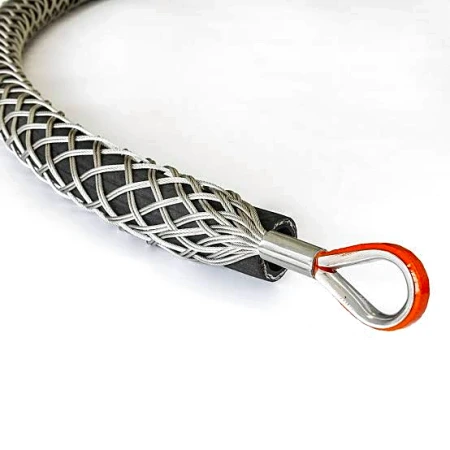
Lift sling rigging company produce Pulling Grips,Wire Pulling Grips,Wire Mesh Pulling Grips,cable socks,pulling socks,sock joint,чорапи за теглене на кабел,cable slipper socks,cable knit stockings.
Pulling Grips
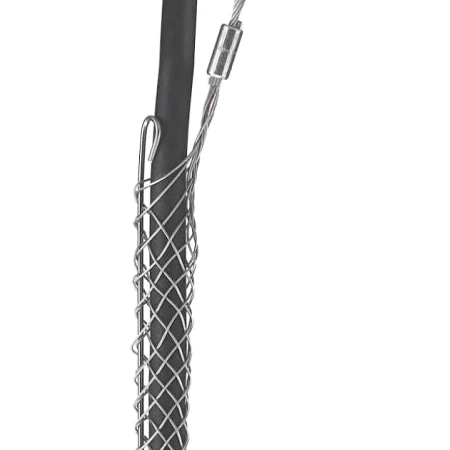
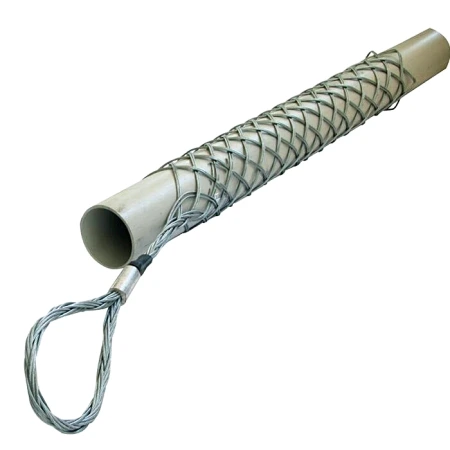
Pulling grips are flexible steel wire mesh sleeves that hold a cable, rope, pipe or duct so it can be pulled, lowered or tensioned. Slide the mesh over the end, напрежение на окото, and the weave closes radially on the jacket: the grip tightens as the pull load rises, so nothing has to be clamped or bolted to the cable. We braid them in our own workshop in galvanised steel or AISI 304 / 316 неръждаема тел, for cable from 9 мм до 160 мм, with single, двойно, гъвкав, въртящи се или изместени очи.
This page covers the range as a whole: how the mesh holds, which of the five constructions suits the pull you are doing, how to size a grip from the cable diameter and the expected line pull, and what the capacity on the label actually means. Each construction has its own page, linked from the table below.
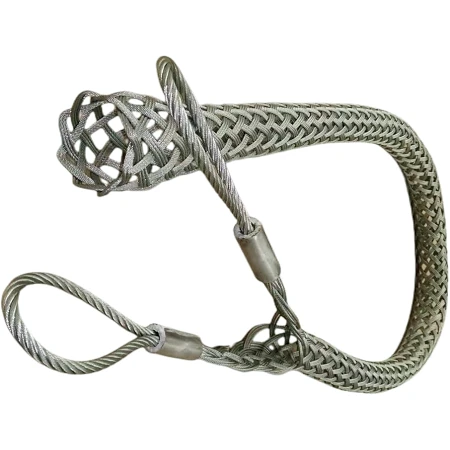
How Wire Mesh Pulling Grips Hold a Cable
There is no mechanism inside a pulling grip. The grip is the weave, and it works in three stages:
- Плъзнете се. Разширете мрежата и я натиснете върху края на кабела, докато кабелът достигне окото. The mesh has to sit on the full gripping length, not just on the cable tip.
- Tension. Load on the eye lengthens the tube slightly and contracts it radially. Every wire in the weave closes on the jacket at once, so the pulling force becomes a uniform clamping force along the whole mesh.
- Освобождаване. Разхлабете влакното и бутнете мрежата напред; the weave opens and the grip slides off. No tools, без белези, no cut jacket.
Because the load is carried by friction spread over the mesh length, capacity comes from engagement length and the number of mesh layers, not from wire gauge alone. А 3.0 mm wire in a 300 mm mesh holds less than a 2.0 mm wire in a 1200 мм мрежа. That is also why a pulling grip can drag a lead-sheathed or thin-wall cable that a clamp would crush, and why the same grip releases without leaving a mark.
Five Constructions, One Principle
Every type below uses the same wire mesh principle. What changes is the head, the way the grip closes, and the material – and those three things decide which pull it suits.
| Строителство | How it closes | Използвайте го, когато | Страница |
|---|---|---|---|
| Cable pulling sock – затворена глава, едно око | Braided closed head, eye at the head | Straight pulls into a clean duct or conduit, cable end free | Чорапи за теглене на кабели |
| Double eye pulling grip | Braided closed head with two eyes | Two lines, lashing, or a pull that has to be turned in line | Double eye grips |
| Offset eye pulling grip | Eye set off the mesh axis | Tight manholes and wall entries where the line must clear the duct wall | Offset eye grips |
| Lace-up hoisting grip | Split mesh laced around the cable | A cable already installed, or a grip that cannot slide over a free end | Lace-up grips |
| Non-metallic pulling grip | Aramid or polyester mesh, без метал | Live circuits, fragile insulation, work where steel near conductors is not allowed | Non-metallic grips |
Material is a separate choice: the closed-head range is available in galvanised steel, AISI 304 или 316 неръждаема.
Sizing a Pulling Grip: Three Numbers
Three measurements decide the model, and getting them wrong is the usual reason a grip slips on the first pull.
- The true outside diameter where the mesh will sit. Measure over the jacket, over any tape or bedding, and over the whole bundle if you are pulling more than one cable. Nominal size is not the gripping size.
- The mesh length you can engage. A grip needs at least four to five times the cable diameter in mesh contact. Less than that and the load concentrates at the head.
- The expected line pull at the worst point of the run – start of pull, through bends, up a slope. The published capacity is a working load; keep the pull below it and add margin on a wet, greasy or polished jacket.
| Cable outside diameter | Minimum mesh engagement (4-5 x OD) | Standard mesh length | Модел |
|---|---|---|---|
| 9-16 мм | 40-80 мм | 300 мм | CPS-16 |
| 16-25 мм | 64-125 мм | 450 мм | CPS-25 |
| 25-38 мм | 100-190 мм | 600 мм | CPS-38 |
| 38-50 мм | 150-250 мм | 700 мм | CPS-50 |
| 50-75 мм | 200-375 мм | 900 мм | CPS-75 |
| 75-100 мм | 300-500 мм | 1200 мм | CPS-100 |
| 130-160 мм | 520-800 мм | 1500 мм | CPS-160 |
Standard range shown. Mesh up to 3000 mm and diameters outside this table are made to order.
Standard Range and Pulling Capacity
The chart below is the standard galvanised range. Capacity is quoted as a working load with a 5:1 safety factor on the breaking strength, measured with the mesh fully engaged on a clean, dry cable.
| Модел | Cable OD (мм) | Дължина на мрежата (мм) | Mesh wire (мм) | Капацитет на теглене (кг) |
|---|---|---|---|---|
| CPS-16 | 9-16 | 300 | 1.5 | 750 |
| CPS-25 | 16-25 | 450 | 2.0 | 1,300 |
| CPS-38 | 25-38 | 600 | 2.0 | 1,800 |
| CPS-50 | 38-50 | 700 | 2.5 | 2,500 |
| CPS-75 | 50-75 | 900 | 2.5 | 3,500 |
| CPS-100 | 75-100 | 1200 | 3.0 | 5,000 |
| CPS-160 | 130-160 | 1500 | 3.0 | 8,000 |
A wet, oily or highly polished jacket reduces friction and therefore capacity – confirm the rating for those conditions before the first pull.
Pulling Grips – Спецификация
| Параметър | Спецификация |
|---|---|
| Име на продукта | Pulling grips / захват за издърпване на телена мрежа / чорап за издърпване на кабел / cable stocking |
| Строителство | Double-layer cross-woven tubular wire mesh; closed braided head, or split mesh laced closed |
| Мрежест материал | Galvanised steel wire as standard; AISI 304 или 316 неръждаема; aramid or polyester for the non-metallic version |
| Диаметър на мрежата | 1.5 / 2.0 / 2.5 / 3.0 мм, selected by cable diameter and pull load |
| Диапазон на диаметъра на кабела | 9-160 мм в стандартните модели; larger made to order |
| Дължина на мрежата | 300 / 450 / 600 / 700 / 900 / 1200 / 1500 мм; обичай до 3000 мм |
| Капацитет на теглене | 750-8,000 kg working load across the standard range |
| Коефициент на безопасност | 5:1 върху номиналната якост на скъсване |
| око / тип глава | Неженен, двойно, гъвкав, rotating, offset or thimble eye; braided eye or swaged ferrule |
| Coating | Plain; PVC or rubber coated; colour coating for size coding |
| Работна температура | -40 C to +120 В; coated versions to about +70 В |
| Маркиране | Модел, cable range and capacity on the label or the ferrule tag |
| Персонализиране | Mesh length and diameter, wire gauge, тип очи, лого маркировка, private-label packing |
| Произход | Lift Sling Rigging Co., ООД – Тайджоу, Дзянсу, Китай |
Eye and Head Options
The head decides how the pulling line meets the grip, and it is the part that has to pass a duct mouth, a sheave or a manhole cover.
- Single braided eye – един цикъл, for a straight pull in a clean duct.
- Двойно око – two loops for lashing, or for two lines pulled in line.
- Гъвкаво око – a swaged ferrule eye that articulates, so the grip stays aligned through bends.
- Въртящо се око – lets the cable spin out its own lay on long runs without twisting the mesh.
- Офсетно око – keeps the line clear of the duct wall where headroom is tight.
- Thimble eye – a hard wear surface inside the eye where it rubs a hook, shackle or winch line.
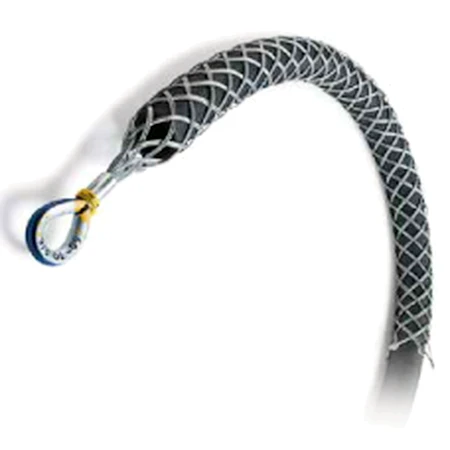
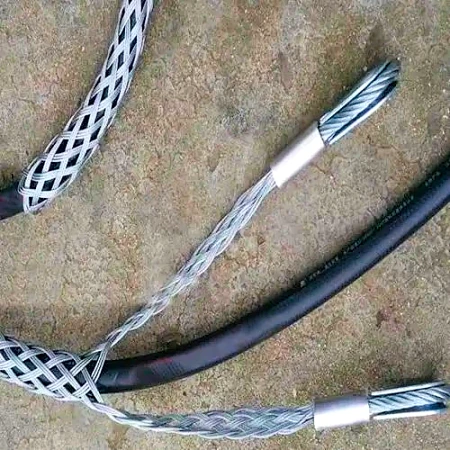
Galvanised, Stainless or Non-Metallic
Material is decided by the environment the grip works in, not by the pull load.
| Мрежест материал | Environment | What it buys you |
|---|---|---|
| Galvanised steel wire | General site, duct, trench, indoor plant | Lowest cost per grip; the zinc layer wears at duct mouths and sheaves over repeated pulls |
| AISI 304 неръждаема | Wet tunnels, зони за измиване, general outdoor | No coating to wear off, no rust staining on white duct or painted pipe |
| AISI 316 неръждаема | Offshore, крайбрежен, chemical and desalination plant | Molybdenum for chlorides; the version that survives salt and de-icing spray |
| Мрежа с PVC или гумено покритие | Боядисани, polished or stainless pipe | Prevents marking; working temperature to about +70 В |
| Aramid or polyester mesh | Live circuits, fragile insulation, фибри | No metal anywhere near the conductor |
What the Capacity on the Label Means
Every grip is rated at a 5:1 фактор на безопасност on its breaking strength, so a CPS-50 with a 2,500 kg capacity has been built to hold about 12,500 kg before it fails. The 2,500 kg figure is the working load: it is what you are permitted to pull, not what the grip can survive.
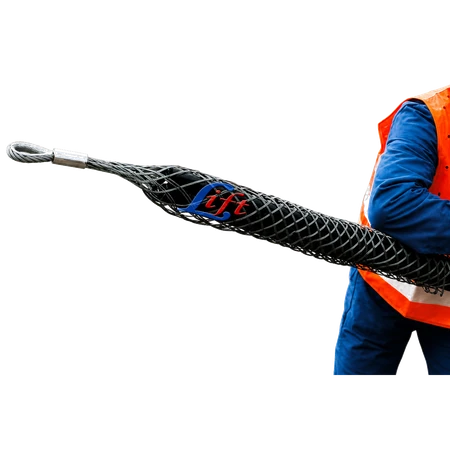
Two practical consequences. Първо, do not use the breaking strength as a target – a grip taken to its break has already damaged the cable and the mesh. Второ, a pulling grip is a pulling and holding tool, not a lifting sling: unless the model is rated and marked for lifting, keep it on the horizontal pull, the duct and the cable drum.
Fitting and the First Pull
- Inspect the mesh, eye and ferrule before every use – скъсани проводници, a deformed eye or a slipped ferrule retire the grip.
- Expand the mesh fully and slide it on until the cable end reaches the eye. Half-engagement is the most common cause of a pull that lets go.
- Дръжте издърпването в една линия с оста на мрежата; side loading concentrates the grip on one edge of the weave.
- Take up the slack slowly and watch the mesh close. If it slips at low load, the grip is too large for the diameter or the jacket is too smooth – stop and re-size rather than pulling harder.
- Никога не превишавайте номиналния капацитет, and never stand in line with a loaded pull line.
Проверка и пенсиониране
- Broken or lifted wires anywhere in the weave – the grip has lost section and capacity.
- A deformed, stretched or opened eye, or a ferrule that has slipped on the rope.
- Corrosion pitting on galvanised mesh, or a coating worn through to bare wire.
- Mesh that no longer closes on the cable, or that has been pulled out of shape.
- Any grip involved in a slip or an overload: пенсионирайте го, do not re-use it on a lighter job.
Record the pulls and the damage. A grip is cheap next to the cable it is pulling, and a mesh that has been dragged through a rough duct mouth is not the same grip it was on the first pull.
Where Pulling Grips Are Used
- Pulling LV, MV and HV power cable, control cable and fibre optic cable through ducts, trenches and risers
- Pulling cable bundles, wire rope and rods with winches, capstans and cable pullers
- Handling steel pipe, PVC and PE pipe, conduit, hose and ducting
- Supporting or lowering smooth cylindrical loads where a clamp would crush or mark the surface
- Telecom, utility, тунел, substation, offshore and marine installation work
Braiding, Testing and Documentation
Lift Sling Rigging Co., Ltd разполага с такелаж от плетени телени въжета и мрежи в Тайджоу, Jiangsu for close to thirty years. Every grip is braided from wire we select, окото е сплетено или извито до контролирана дължина, и пробите се зареждат преди изпращане. При поискване могат да бъдат организирани доклади за проверка преди изпращане и тестване от трета страна; нашият certification page lists the management systems behind the process.
OEM is routine: дължина на мрежата, mesh diameter, wire gauge, тип очи, coated colour for size coding, logo marking and private-label packing. Send the cable diameter and the pull load and we will quote the model rather than a range.
Често задавани въпроси
What are pulling grips used for?
Holding a cable, rope, pipe or duct so it can be pulled, lowered or tensioned. The mesh closes on the jacket as the pull load rises, which spreads the gripping force along the cable instead of clamping it at one point.
Is a pulling grip the same as a cable sock?
да. Pulling grip, cable sock, cable stocking, mesh grip and pulling stocking all describe the same article: a braided wire mesh tube with an eye at the head. The names come from different trades – cable jointers say sock, riggers say grip.
How do I choose the size?
Measure the true outside diameter where the mesh will sit, then check that the model’s range covers it and that you have at least four to five times the diameter in mesh engagement. A grip that is too large slips; one that is too small will not slide on.
How much can a pulling grip hold?
The standard range runs from 750 kg on the CPS-16 to 8,000 kg on the CPS-160, quoted as working loads at a 5:1 фактор на безопасност. Капацитетът зависи от повърхността на кабела, mesh length and the number of mesh layers, so confirm the figure for your cable before the first pull.
Will a wire mesh grip damage the cable jacket?
Not in normal use. The load is distributed over the mesh length rather than concentrated, which is why grips are used on lead sheath, thin-wall insulation and fibre. За боядисани, polished or stainless pipe, specify a PVC or rubber coated mesh to avoid surface marking.
Can I fit one to a cable that is already installed?
да – use a lace-up or split mesh grip, which is wrapped around the cable and laced closed instead of being slid over a free end. Вижте lace-up hoisting grips страница.
Can a pulling grip be used for lifting?
Only if the model is rated and marked for lifting. A standard pulling grip is a pulling and holding tool; using an unrated grip as a lifting sling puts a factor of five between the load and a failure that no one has calculated.
Can you make a custom length, eye or branded grip?
да. Mesh length from 300 мм до 3000 мм, cable diameters outside the standard range, единичен, двойно, гъвкав, rotating, offset or thimble eyes, coated colours for size coding, logo marking and private-label packing.
Request a Pulling Grip Quotation
Send the cable or pipe diameter, the mesh length you can engage, the eye type and the expected line pull – plus the environment, if it is wet, salty or likely to mark the surface. We will come back with the model, the capacity and a factory-direct price.
Send your pulling grip specification
Свързани продукти
- Чорапи за теглене на кабели – затворена глава, едно око
- Дръжки за издърпване на кабела с двойно око
- Ръкохватки за теглене на кабел с изместено око
- Дръжки за повдигане с връзки – for installed cable
- Non-metallic cable pulling grips – no metal near conductors
- Здрава ръкохватка за издърпване на кабел от неръждаема стомана
- All wire rope slings and pulling equipment