

Lift sling rigging company produce Oven Door Sealing Rope,Furnace door sealing rope,High Temperature Resistant Rope,fireproof rope,Fireplace Sealing Tape.
Oven Door Sealing Rope
A braided fiberglass sealing rope for oven doors, furnace doors and vessel mouths. 3–25 mm round or square section, 540 °C continuous in the standard glass grade, on the coil or cut to door size — and specified by the compression it holds, not by its temperature number.
The rope lies in a groove in the door frame and the door closes on it. That is the whole mechanism, which is why this page is mostly about compression, groove geometry and braid density rather than heat.
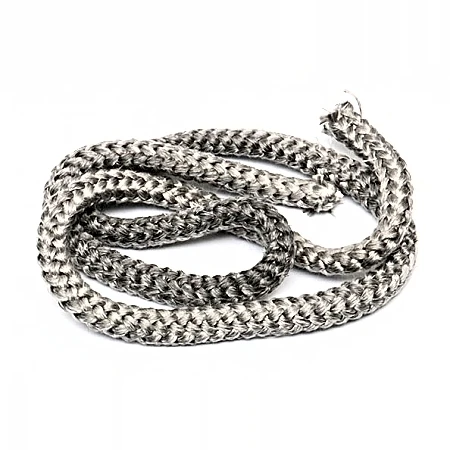
A Door Seal Is a Spring, Not a Barrier
An oven door joint is measured in tenths of a millimetre, and it is held by pushing back. The door closes and compresses the rope; at temperature the casting grows and bows; when it cools it comes back. The seal follows all three movements, because a 0.2 mm gap along a firebox door shows in the room as smoke.
So the first number worth checking is not the temperature rating. It is how much of the section returns after compression. Braid gives that structurally: each strand runs a longer path than the rope axis, so radial compression is taken partly as a change of braid angle instead of crushed filament. A solid gasket — ceramic board, fibre sheet, machined graphite — compresses once, takes a set, and by the second thermal cycle the door is closing on a hard, thinner copy of its original shape.
Round Braid or Square Braid
Both are braided glass, both seal, and they are not interchangeable — the groove decides. Round braid rolls into a machined round groove or a channel with a flat lip, needs no orientation, and gives the most compression travel per millimetre of section. Square braid puts more material into the same groove width, sits flat on a cast face, and will not roll when the hinge is not parallel to the frame.
| Round braid | Square braid | |
|---|---|---|
| Groove it wants | Round or U-section channel | Rectangular groove, flat-faced door |
| Compression travel | Highest per mm of section | Less travel, more contact area |
| Behaviour on a swinging door | Can roll if the groove is shallow | Stays put, resists twisting |
| Contact with the door face | Line contact, clear witness mark | Flat contact over a wider land |
| Typical use | Stove and oven doors, boiler doors | Kiln doors, cast-iron ranges |
When replacing, measure the groove rather than the old rope: a rope compressed for years is often 10–15% thinner than the section that has to go back into the same channel.
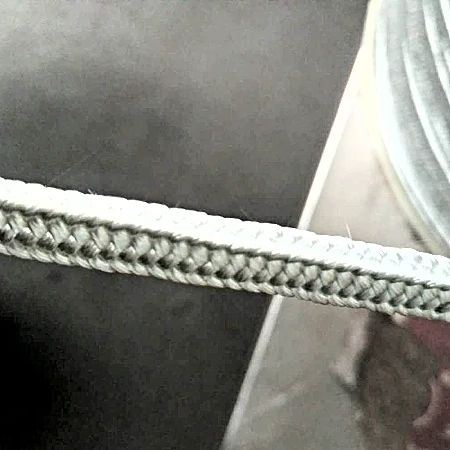
How Hot, and Where You Measure It
Three material grades, and in every case the limit is the temperature at the rope — not the flue gas, not the set point. On a wood stove the seal sits behind the firebox lip and usually runs 100–200 °C below the flue; on a kiln door it can run hotter than the chamber reading, because the rope faces the load.
| Grade | Continuous | Short peak | Use it when |
|---|---|---|---|
| E-glass (standard) | 540 °C | 650 °C | Ovens, stoves, boiler and dryer doors; the default grade |
| Silica | 1,000 °C | 1,200 °C | Kiln and furnace doors, high-radiance positions |
| Alumina-silicate ceramic | 1,200 °C | 1,260 °C | Where glass would devitrify; more brittle, wider groove |
Past its grade the failure is not a flame. The glass devitrifies: filaments crystallise, go brittle, and the braid powders away under the door’s own movement. On site it reads as wear, and it is a temperature problem. If you are changing the same seal at the same interval for the second time, move up a grade before changing anything else.
The Braid Is Where the Elasticity Comes From
Glass filament is not elastic in any useful sense — about 4% elongation, then brittle failure. The springiness of a sealing rope is a property of the structure, not the material, which is the distinction that “flexible and resilient” on a data sheet tends to blur.
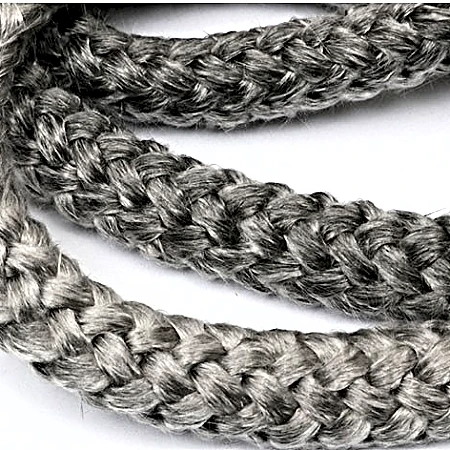
A braid is a lattice of helical strands. Compress it radially and the helix angle opens; release it and the angle closes again, returning the section. What that costs, and how much comes back, is set at the braider:
- Picks per metre. A tight braid is firmer, holds its section at temperature and resists being pushed into the groove — but it needs more closing force and will not fill an irregular gap.
- Carrier count. At the same diameter, a 16-carrier braid is a denser, harder rope than an 8-carrier one.
- Core. Hollow braid compresses furthest; a stainless wire core holds shape and takes the pull of a door that is yanked open, at some cost in compressibility.
Specifications
| Construction | Braided round or square section; 3-strand twisted on request |
|---|---|
| Material | E-glass filament · silica · alumina-silicate. Asbestos-free |
| Round diameter | 3, 4, 5, 6, 8, 10, 12, 14, 16, 20, 25 mm |
| Square section | 6×6 to 25×25 mm |
| Diameter tolerance | ±0.5 mm up to 10 mm; ±0.8 mm above |
| Service temperature | 540 °C continuous / 650 °C peak (E-glass) |
| Braid | 8, 12 or 16 carrier; picks per metre set to the groove |
| Reinforcement | Stainless steel wire core, optional |
| Finish | Uncoated, or graphite-impregnated for release and lubricity |
| Weight, approx. | 6 mm ≈ 55 g/m · 10 mm ≈ 150 g/m · 16 mm ≈ 380 g/m · 20 mm ≈ 600 g/m |
| Supply length | 10 / 20 / 50 m coils, spools, or cut to door size |
The same plant braids the aramid braided rope for duties that need strength at temperature rather than a seal, and the high heat resistance mooring rope for lines that stay hot under load.
Groove Sizing: the Three Numbers We Need
A sealing rope is quoted from three dimensions, two minutes with a caliper: groove width, groove depth, and the gap left when the door is shut. From those, section and compression follow:
| Rope Ø | Groove width | Groove depth | Stands proud | Compression closed |
|---|---|---|---|---|
| 6 mm | 6 mm | 4.0 mm | 2.0 mm | 33% |
| 8 mm | 8 mm | 5.5 mm | 2.5 mm | 31% |
| 10 mm | 10 mm | 7.0 mm | 3.0 mm | 30% |
| 12 mm | 12 mm | 8.5 mm | 3.5 mm | 29% |
| 16 mm | 16 mm | 11.0 mm | 5.0 mm | 31% |
| 20 mm | 20 mm | 14.0 mm | 6.0 mm | 30% |
| 25 mm | 25 mm | 17.5 mm | 7.5 mm | 30% |
On a retrofit with no machined groove, send the width and the gap and we will pick a section that over-fills slightly rather than under-fills. Too small is a leak; too large stops the door seating, bows the casting, and leaks somewhere else.
Fitting It Without Building In a Leak
- Cut at rest length, never stretched. A rope pulled to make the ends meet is thinner everywhere it was pulled, and that run is where it smokes.
- Cut square with a sharp blade, tape before cutting so the braid does not unravel.
- Butt the ends, do not overlap. Put the joint at the bottom of the door or in a corner, never at the top.
- Bed it sparingly in high-temperature cement — enough to hold the rope, not enough to sit as a layer between rope and door face.
- Cure before firing: about an hour at 100 °C, then an hour at 200 °C. Firing a wet seal steams the cement and lifts the rope.
- Close the door and read the witness mark. A continuous bright line is contact; a broken line is the leak, and it will be there after the next firing too.
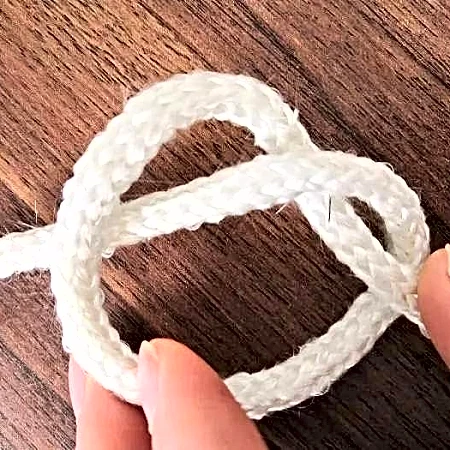
What a Failed Seal Tells You
| Symptom | What it means | What to change |
|---|---|---|
| Flat, hard, no spring left | Compression set — over-compressed or over-temperature | Deeper groove, or one grade up |
| White powder in the groove | Abrasion: the rope moves because it is not locked | More compression, tighter braid |
| Burned through in one spot | Flame path through a local gap or a warped door | Check door flatness, not the rope |
| Black streaks at a corner | Butt joint has opened | Re-cut, butt at the bottom, cement the ends |
| Thinner along one side | Stretched during fitting | Re-fit at rest length |
When the Rope Seals a Vessel Mouth, Not a Door
The same braid packs the mouth of a vessel, container, crucible or canister lid — an annular gap closed by a clamp, a screw ring, or the weight of the lid. Two things change from the door case.
Compression is set by the clamp rather than a hinge, so the groove is sized to the clamp travel and a slightly larger section is used; check that the clamp still reaches its stop with the rope in place. And dust matters: an uncoated rope sheds a little fibre when worked, harmless on a furnace door and not acceptable over an open product — specify the uncoated grade in a tight braid and keep graphite out of the contact zone.
Above the glass grade the duty goes to aramid, which brings its own limits on stretch and creep; where the plant needs a radiant barrier rather than a seal, that is a net — see the aramid net with knots.
Send the three groove numbers, get the section
Groove width, groove depth and the gap when closed, with the service temperature. We will come back with diameter, braid and length, plus a sample for trial fitting.
WhatsApp / phone: +86 180 6600 2268 · Office: +86 523 8693 5818
Email: lift98@jslift.com · 702461526@qq.com
Frequently Asked Questions
Is a fiberglass sealing rope elastic?
Not in the rubber sense — the filament elongates about 4% and then breaks. The rope behaves elastically because of its braid: radial compression opens the braid angle, and the angle closes again on release. Braid density, not material alone, decides how well the seal recovers.
What temperature can an oven door sealing rope take?
Standard E-glass runs 540 °C continuously with short peaks to about 650 °C. Silica goes to 1,000 °C and alumina-silicate ceramic to 1,200 °C. Measure at the rope after a full cycle rather than quoting the set point.
Round or square section?
Round for a round groove or a channel with a flat lip, and a hinge parallel to the frame. Square for a rectangular groove, a flat cast door, or a hinge that lets the door twist as it closes.
How much should the rope be compressed?
25–30% of its diameter with the door shut. Below 20% the joint is not closed; above 40% the filaments crush and the rope takes a set, which shows up as a leak within the first few firing cycles.
Will it shed fibre?
A new uncoated rope sheds a little loose filament when first handled. A tight braid sheds less in service and a graphite-impregnated rope sheds least, which is why the coated grade is preferred next to a product or an air intake.