

Lift sling rigging company produce Truck Cargo Net,Adjustable Truck Cargo Net,Heavy Duty Truck Cargo Net,Truck Bed Cargo Net .
Truck Cargo Net
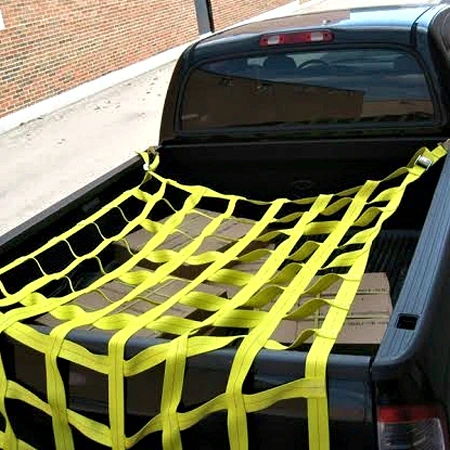
A truck cargo net is a high-strength polyester net stretched over the load in a pickup bed, a flatbed or a light truck, hooked to the body and tensioned down. It keeps the top of the stack where it was put, stops light items lifting out at speed, and turns a loose load into one that looks – and is – covered. It is one of the safety rope net products made in this works, in rope or in webbing, to the size of the vehicle.
What it is not is a substitute for lashing. A net holds the face of a load and stops the top layer moving; it does not hold several tonnes of steel against a brake application. The honest division of work is that the net covers and contains, and the cargo lashing or heavy duty ratchet tie-down straps take the mass. Every page that sells a net without saying so is selling a habit that ends in a claim.
What the net is for
Three jobs, and a net that does all three is doing what it was bought for.
- Keeping the top down. Cartons, bags and empty containers lift at speed. A tensioned net puts a distributed load on the top layer, which is exactly where light cargo leaves a vehicle.
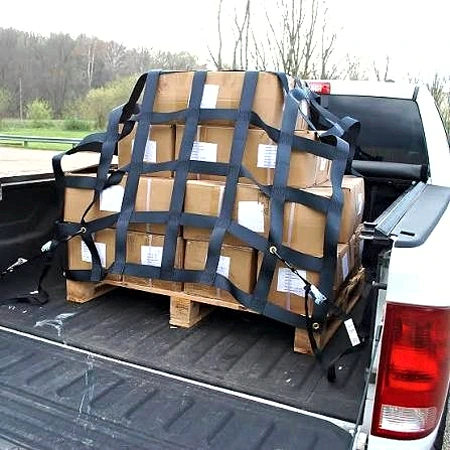
- Containing the small stuff. A net over a pallet stops the top cartons walking, and it stops a bag of sleeves, a cone or a toolbox sliding off the back at the first roundabout.
- Making the load legible. A covered load is visibly a secured load, to a driver, a loader and an inspector at the roadside. That is worth more than it sounds when a load is checked in a hurry.
What it does not do is restrain mass. A 1.2 t pallet of bricks needs lashing to the bed, and the net goes over the top afterwards; a net alone on a heavy load is decoration. Where the load is heavy, the net is the second layer, never the first.
Rope or webbing
| Rope net | Webbing net | |
|---|---|---|
| Feel and weight | Softer, folds small, stretches a little under load | Firmer, heavier, holds its shape on the load |
| Coverage | Round strands let small items show through; kinder to paintwork | Flat strands close the gaps; better on cartons and bags |
| Where it wins | General cargo, garden and farm use, loads that are not square | Pallets, cartons, bins, flatbeds and anything that has to look tidy |
| Repair | Re-knotted or re-spliced on site | Re-stitched at a bench |
| Life outdoors | Good in polyester; nylon softens and stretches when wet | Good; heavier, so it stays put in wind |
Mesh: fine enough for the load
The mesh is chosen by the smallest thing that must not come through, not by the size of the vehicle. A 100 mm mesh over cartons is fine; the same net over gravel is a sieve.
| The load | Mesh | Why |
|---|---|---|
| Cartons, boxes, flat-packed goods | 45 – 60 мм | Nothing in the load fits through; the net closes on the corners |
| Bags, sacks, soft packaging | 45 – 60 мм | Bags deform into any gap that is wider than the bag’s shoulder |
| Pallets and stillages | 75 – 100 мм | Open mesh hooks over the pallet corners and reads as a cover |
| Bins, crates, machinery | 75 – 100 мм | The net holds the shapes, not the contents |
| Sand, gravel, aggregate | 25 – 45 mm plus a sheet | A net alone will not hold aggregate; it holds the tarpaulin over it |
Sizing to the vehicle
Nets are sold by the bed, and the bed is measured at the hooks rather than at the panels – a net that is right for the load area and short at the corners will not tension.
| Vehicle | Bed (about) | Net to order |
|---|---|---|
| Pickup, double cab | 1.5 x 1.6 м | 1.8 x 1.8 м, elastic edge, 8-10 hooks |
| Pickup, single cab / long bed | 2.4 x 1.6 м | 2.6 x 1.8 м, elastic edge or border with straps |
| Light truck, 4.2 m body | 4.2 x 2.0 м | 4.5 x 2.2 м, border rope and 12 hooks |
| Truck, 6.8 m body | 6.8 x 2.3 м | 7.0 x 2.4 м, two panels or one long net |
| Trailer or curtain-side, 13 м | 13.0 x 2.4 м | 13.5 x 2.5 м, split into two panels for handling |
Nominal bed sizes. Measure the load area and the hook positions: the net has to reach the hooks with enough left to tension, і а 200 mm shortfall cannot be pulled out.
Hooking and tensioning
- Hook to the body, not to the load. Bed hooks, D-rings, the rail along the side – whatever the vehicle actually has. Hooking a net to a carton strap means the net moves when the load does.
- Elastic edge or tensioned border. An elastic edge is quick and kind to a pickup; a border rope with hooks or a strap and ratchet gives a firmer cover on a flatbed and a load that will not settle.
- Pull down, then along. Tension the middle first so the net sits on the crown of the load, then work out to the corners. A net tensioned corner-first bridges the load and leaves the middle loose.
- Do not hook to thin panel work. A hook that pulls out of a wing or a plastic liner is worse than no hook: it leaves a hole, and the net lets go under load.
- Take up the slack after the first kilometre. Loads settle. A net that was tight at the yard is often slack by the first service station, and that is when the top layer starts to move.
The load that stays put
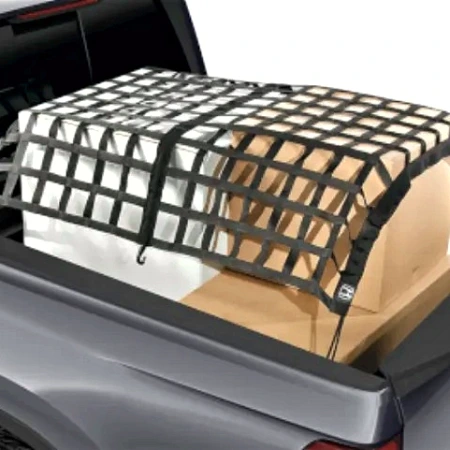
A net cannot fix a badly built load. Three habits do more for load security than any net:
- Stack flat and fill the bed. A pyramid of cartons under a net is a load with a void in it, and voids move.
- Keep the height below the headboard where the vehicle has one; the headboard takes the forward load, the net takes the top.
- Put the heavy items on the floor and against the front, and let the net deal with what is light and high.
Weather, and the working life
Polyester is the default for a net that lives on a vehicle: it takes UV better than nylon, holds its colour, and does not go slack in the rain the way a wet nylon net does. Snow and salt are the harder test – a net left packed wet with road salt will stiffen at the knots before the strands fail.
The working life of a truck cargo net is set by sun and by abrasion, in that order: a net used daily on an open bed will fade and stiffen in two or three summers, while the same net on a covered truck lasts far longer. Rinsing it, drying it and storing it out of the sun is the whole of the maintenance.
Not the same as a container net
The two are often bought by the same person and they are not interchangeable. A container cargo net is a barrier hung inside a container door, sized to the box and hooked to its lashing points; a truck cargo net is a cover over a load, sized to a bed and hooked to the body. A pallet cargo net is the third variant – a small net for one pallet – і а cargo lifting net is a rated article that carries a load in the air and is a different product altogether.
Агляд, and what retires a net
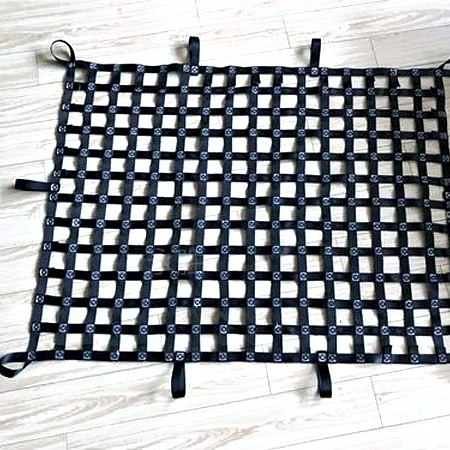
- A cut or a chafed strand at the border, where the net rubs on the bed rail every time it is used.
- UV-stiffened webbing – a net that has gone hard and faded has lost strength before it looks worn out.
- A hook that has opened, or an elastic edge that no longer returns: the net will flap and the load will lift.
- Knots that have drawn or a splice that has started to slip.
- Anything that will not lie flat any more: a net that has stretched out of shape cannot be tensioned onto a load, and a slack net is a flag, not a cover.
Six lines on the enquiry
| # | The line | What it fixes | What goes wrong without it |
|---|---|---|---|
| 1 | Vehicle and measured bed, plus hook positions | The size and the hook count | A net that reaches the bed but not the hooks |
| 2 | What the load is, and the smallest thing in it | The mesh | A mesh the load falls through, or one that blinds over |
| 3 | Rope or webbing | The construction and the weight | A net too heavy to handle, or too light to lie flat |
| 4 | Elastic edge, border with hooks, or ratchet | The edge and the fixing | A pickup net specified like a flatbed net, or the reverse |
| 5 | Колер, and whether it has to match a fleet | The dye lot | A shade that does not match the livery |
| 6 | Whether it needs to be branded or bagged | The label and the packing | A net that arrives loose when it was meant to be a kit |
Frequently asked questions
What is a truck cargo net for?
It covers and contains the load in a pickup bed, flatbed or light truck: it keeps the top layer down, stops light items lifting out at speed and holds the small things that would otherwise slide off. It is not a substitute for lashing a heavy load.
Will it stop my load falling out?
It will stop the top layer and the light items, which is where most losses start. It will not hold a pallet of bricks against braking – that is what lashing is for, and the net goes over the top afterwards.
What mesh size do I need?
Fine enough for the smallest item in the load. 45-60 mm covers cartons, bags and flat-packed goods; 75-100 mm suits pallets, bins and machinery. For sand or aggregate a net alone is not enough – it holds the sheet over the load, not the material.
Elastic edge or straps?
An elastic edge is quick to fit and suits a pickup used daily; a border with hooks, or a strap and ratchet, gives a firmer and flatter cover on a flatbed and on loads that settle. Many fleets use elastic on light vehicles and tensioned borders on trucks.
How do I measure for one?
Measure the load area and the positions of the hooks, then add enough to reach the hooks with slack to tension. A net that measures exactly the bed will be short at the corners, because the corners are where the distance is greatest.
Can it be used on a trailer or a curtain-side?
так, as a cover over the load or as a rear closure. Long beds are usually split into two panels, because a 13 m net is heavy and awkward to throw and to store.
Is a truck cargo net the same as a container net?
няма. A container cargo net is a barrier hung inside a container door and sized to the box; a truck cargo net is a cover over a load and sized to the bed. The materials are the same and the jobs are not.
How long does one last?
Two to three summers on an open bed in strong sun, longer on a covered truck. Sun and abrasion at the border end it first, so rinsing, drying and storing it out of the light is most of the maintenance.
Where the rest of the detail lives
- Container cargo net – the barrier hung inside a container door
- Pallet cargo net – the small net for a single pallet
- Climbing net – the same material, made to be climbed
- Safety rope net – the category page
- Cargo lashing – the restraint that carries the mass
- Ratchet tie-down straps – hooks, tension and the load limit
Кантакт
Lift Sling Rigging Co., Ltd weaves the webbing, knots the rope and makes the net in one works.
Send the frame, the size and who climbs it. We confirm the mesh, the border, the lacing and the colour in writing before the net is cut.
- Telephone and WeChat: 18066002268
- Электронная пошта: 702461526@qq.com
- Адрас: Індустрыяльны парк Ліфутэ, Горад Тайчжоу, Правінцыя Цзянсу, Кітай
- Код HS: 630790