

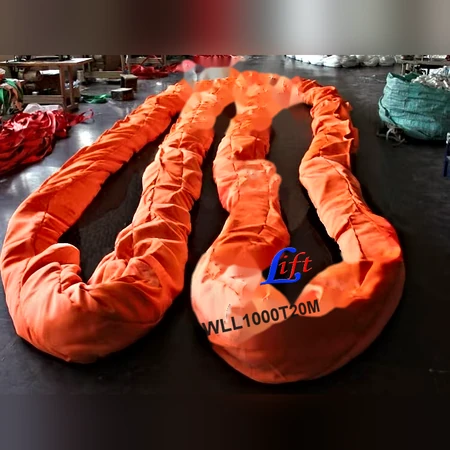
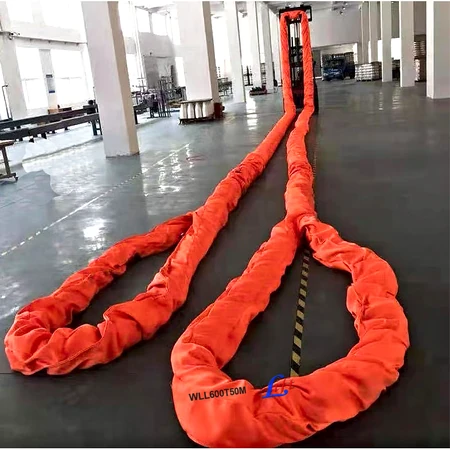
Lift sling rigging company produce 1100 Tonne Round Sling,1100 ton lifting sling,1100t Heavy Duty Soft Round Sling for Lifting,1100Tonne UHMWPE Endless Round Sling,1100Ton Eye-Eye Round Sling.
1100 Tonne UHMWPE Round Sling
А 1100 tonne UHMWPE round sling is rated 1,100,000 kg on a single vertical leg: a continuous loop of UHMWPE (Dyneema) yarn inside a double-layer heavy duty sleeve, with a 7,700,000 кг minimum breaking load at 7:1 and a 2,200,000 кг proof load applied to every body before marking.
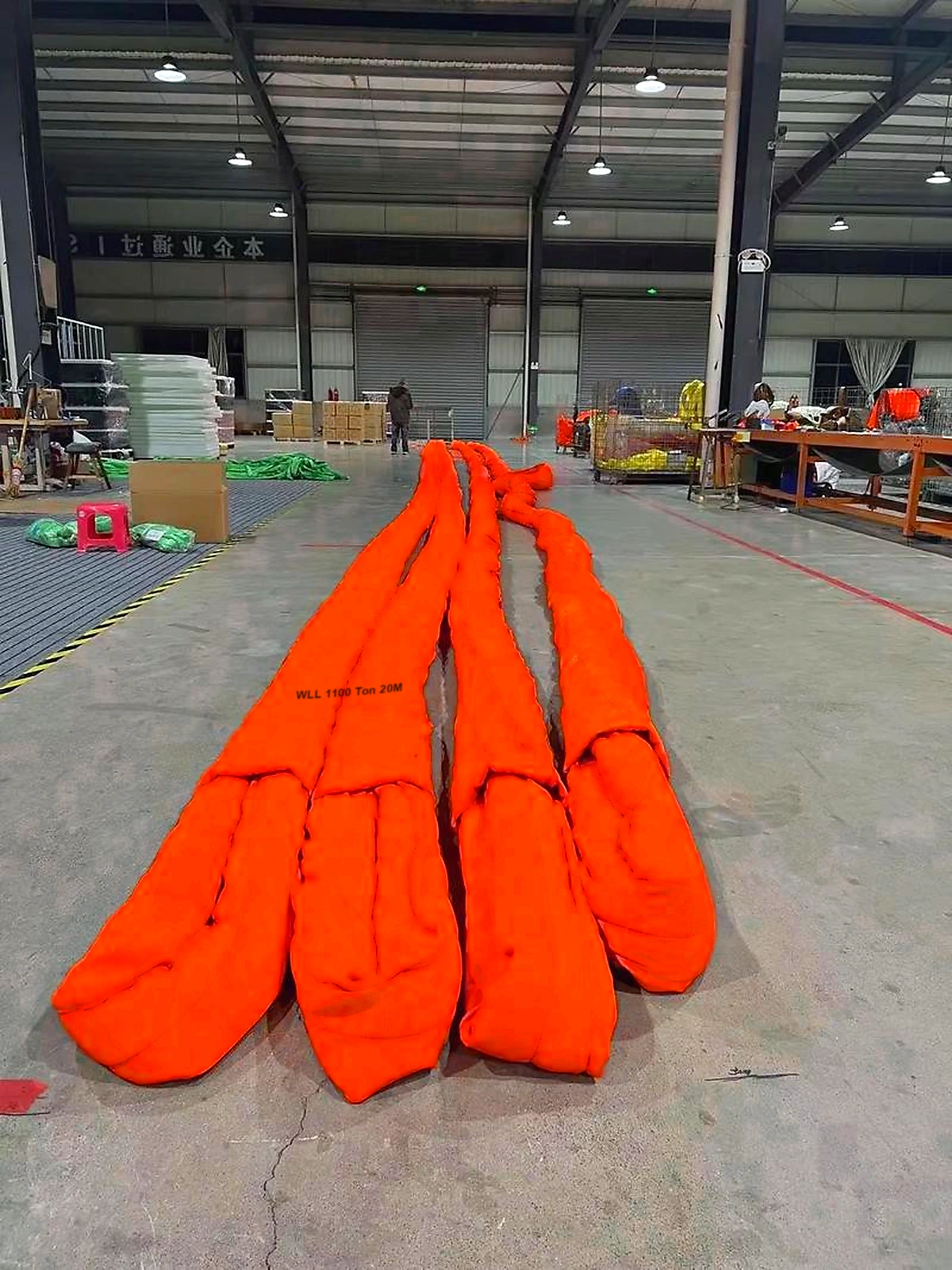
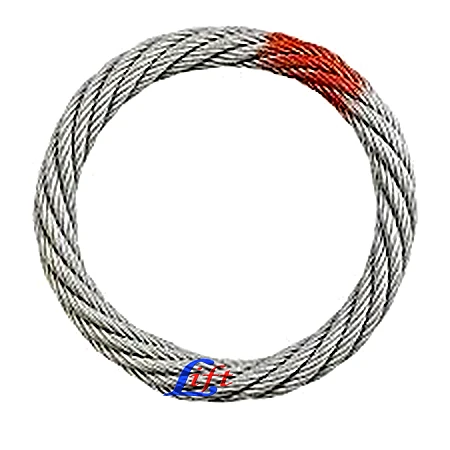
At 1,100 tonnes there are only two serious options: this sling, or a wire rope grommet. Both will lift the load — neither is the “safe” choice by default. What separates them is four things, and strength is not one of them.
Four Things Decide It, Not Strength
| Criterion | UHMWPE round sling | Wire rope grommet |
|---|---|---|
| Mass to handle | Roughly one-seventh. Carried in, dressed by hand. | The baseline. At this rating the grommet is a crane-handled item on its own. |
| Stretch at WLL | About 1–2% of effective length | Under 1% |
| Bend radius | Soft body conforms; a tight radius costs nothing but sleeve wear | Needs a minimum D:d; a tight radius costs capacity |
| How it fails | Sleeve abrasion, cuts, heat. Core is hidden. | Broken wires, nicks, and internal corrosion you cannot see. |
| Inspection | Sleeve and label; the load-bearing core is not visible | Count broken wires, measure diameter — visible by design |
| Heat | Lower ceiling; not for hot work | High |
| Salt water | Nothing to corrode | Galvanising only delays it; internal corrosion is the risk |
Where the Synthetic Wins
You can put it on the hook yourself
At 1,100 tonnes the sling is still a two-person item: no crane to position it, no rigging frame, no waiting for the hook to come back. In a yard where the same hook is doing the lift, that difference decides the shift.
It does not mark the load
Machined faces, coated plate, painted modules, stainless — a soft sleeve touches them without the scoring a steel grommet leaves. On finished surfaces that is often the deciding argument.
Nothing inside it can rot
A grommet’s worst failure mode is internal corrosion between the strands, invisible until it breaks. A synthetic body has no such mechanism; what you can see — the sleeve — is the wear layer, and it is meant to be inspected.
Where Steel Wins
- Heat. Hot work, radiant heat, slag, molten splash — the UHMWPE core has a temperature ceiling the steel does not.
- Stiffness. Precision levelling and matched-length sets are easier when the sling barely stretches. Under 1% against 1–2% is a real difference over a long body.
- An inspection procedure written for wire rope. If the client’s method statement counts broken wires, a synthetic sling does not fit the paperwork, however well it lifts.
- Local availability. Grommets are made in far more shops; more competition, shorter lead time, easier replacement.
The Test That Usually Settles It
Two checks decide most 1,100 t enquiries before price is discussed:
- What radius must it bend around? A grommet has a minimum D:d, and going under it costs capacity. A synthetic body will go around almost anything — the limit is sleeve wear, not strength.
- What is the temperature at the contact point? Not the ambient temperature of the hall — the surface of the load. А 90 °C plate rules out UHMWPE long before any rating table does.
What the Proof Record Has to Show
Every 1100 tonne body is proof loaded to 2,200,000 кг — twice the vertical working load limit — in a bed rated above that figure, and the load applied is recorded against the sling’s serial number. What the record does not cover is the assembly: a four-leg set rated 2,310,000 kg is a lift plan, not a test. The plan carries the leg angles, the share between legs and the rating of the master link above them.
The Numbers You Are Buying
| Arrangement | Mode factor | WLL |
|---|---|---|
| Vertical | 1.0 | 1,100,000 |
| Choked | 0.8 | 880,000 |
| Basket, 0–7° | 2.0 | 2,200,000 |
| Basket, 7–45° | 1.4 | 1,540,000 |
| Basket, 45–60° | 1.0 | 1,100,000 |
| 2-leg set, 0–45° | 1.4 | 1,540,000 |
| 2-leg set, 45–60° | 1.0 | 1,100,000 |
| 3 & 4-leg set, 0–45° | 2.1 | 2,310,000 |
| 3 & 4-leg set, 45–60° | 1.5 | 1,650,000 |
Four labels add up to 4,400,000 кг; the set is rated 2,310,000 кг. The gap is angle and unequal sharing, explained on the 700 tonne page.
Technical Specifications
| Product | 1100 Tonne UHMWPE Round Sling (endless) |
|---|---|
| Эш йөкләмәһе сиге | 1,100,000 kg vertical |
| Minimum breaking load | 7,700,000 кг (7:1) |
| Proof load | 2,200,000 кг, applied to every body |
| Safety factor | 7:1 standard; 6:1 and 8:1 produced to order |
| Core | UHMWPE (Dyneema) parallel yarn, continuous loop, no splice in the load path |
| Sleeve | Double-layer heavy duty woven polyester, replaceable wear pads at the choke points |
| Elongation | About 1–2% at WLL |
| Working temperature | Lower than the polyester version; confirm the yarn grade for hot or sustained-load work |
| Standard | AS 4497:2018; ИН 1492-2 and ISO 4878 on request |
| Effective length | Lay-flat length or full circumference, agreed on the approval drawing |
| Marking | WLL in kg, effective length, core fibre, standard, manufacturer, serial |
| Packing | Coil in a crate or on a pallet, break-bulk |
| HS code | 630790 |
When It Is the Wrong Sling
Three duties belong to another product, whatever the rating says:
- Hot loads — above the core’s temperature ceiling, use an aramid round sling or steel.
- A load left hanging — UHMWPE creeps under sustained tension; take the load off between lifts.
- Bare sharp edges — a sleeve is a wear layer, not armour; protect the edge or change the concept.
Frequently Asked Questions
Is a UHMWPE sling or a wire rope grommet better at 1,100 tonnes?
Both lift the load. The choice is decided by mass, stretch, bend radius and how the item can be inspected — not by strength. Synthetic wins on handling, soft contact and corrosion; steel wins on heat, stiffness and a visible broken-wire inspection method.
How much does a 1100 tonne UHMWPE sling stretch?
Around 1–2% of the effective length at working load: 200–400 mm on a 20 m body. Slightly less than an equivalent polyester sling, more than a grommet, which stays under 1%.
What is the proof load?
2,200,000 kg — twice the vertical working load limit — applied to each body and recorded against its serial before marking.
How much can four 1100 tonne slings lift?
2,310,000 kg with legs at 0–45°, and 1,650,000 kg at 45–60°. The four labels sum to 4,400,000 кг, but a set is never rated on the sum.
Can it be used offshore or in a splash zone?
Yes — there is nothing in the body to corrode, which is the main long-term risk with steel in salt water. Protect the sleeve from abrasion and keep heat away.
Quote a 1100 Tonne UHMWPE Sling
Send the load, the leg arrangement, the effective length and the temperature at the contact point. We will come back with the body, the sleeve, the set rating and the proof record.
Электрон почта: лифт98@jslift.com | Ватсап: +86 158 5088 8888