

Lift sling rigging company produce Heavy Duty Eye & Eye Flat Web Sling,Flat Eye To Eye Polyester Web Sling,Flat webbing eye & eye lifting sling,Polyester Flat Eye & Eye Web Sling.
Heavy Duty Eye & Eye Flat Web Sling
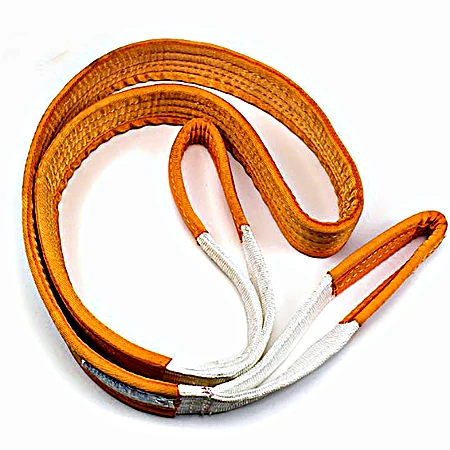
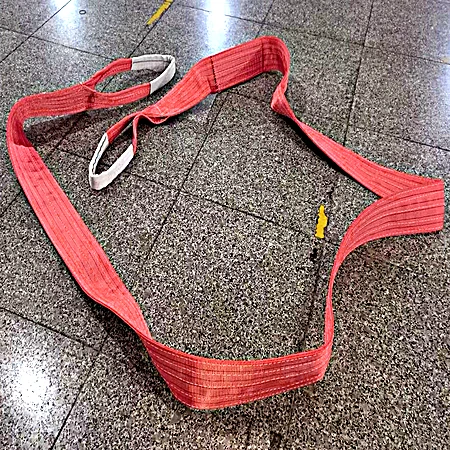
Heavy duty eye & eye flat web sling built for loads a standard band cannot take: 5 t to 48 t per leg, 100 mm aan 300 mm wide, duplex, triplex or quadplex high-tenacity polyester webbing, with a reinforced sewn eye at each end and a wear pad in the eye where the load concentrates. No metal in the sling, so a machined, painted or coated surface arrives exactly as it left. Every sling is made to order, proof-tested and supplied with a sewn label stating its working load limit, lengte, mode and standard.
What makes this a heavy duty sling
A sling becomes heavy duty in five ways, and all five are specified rather than assumed. Die webbing is woven wider and heavier so the load is spread over more square millimetres of band. Die ply count goes up — duplex, triplex and quadplex bands carry more and wear longer, because the outer ply takes the abrasion and the inner plies carry the load. Die eyes are reinforced with extra stitching at the root, where every sling fails first. And the contact points are protected, with a wear pad in the eye and an optional sleeve over the body for steel plate and concrete edges. Finally, the marking is printed into the webbing, not onto a tag that falls off, so the working load limit stays legible for the life of the sling.
- 5 t – 48 t working load limit per leg in the vertical mode, 2, 3 and 4-ply; custom builds above 48 t on request.
- 100–300 mm webbing width in the heavy range (25–300 mm across the full range), so the pressure on the load falls as the capacity rises.
- Reinforced sewn eye at both ends with high-tenacity thread, plus a wear pad in the eye on heavy duty builds.
- No metal anywhere in the sling — nothing to scratch a finished surface, nothing to corrode, nothing to fatigue.
- Low stretch, UV and abrasion resistant high-tenacity polyester, rated to EN 1492-1 with a 7:1 safety factor.
- Made to order in width, lengte, ply, colour, printed marking, own label and packing (OEM / ODM).
Technical parameters
| Product type | Heavy duty eye & eye flat web sling — one sewn eye at each end of a flat webbing band |
|---|---|
| Webbing material | 100 % high-tenacity polyester (PET); nylon webbing on request |
| Webbing width | 100 / 150 / 200 / 240 / 300 mm (heavy duty range); 25–300 mm across the full range |
| Ply | Duplex (2-ply), triplex (3-ply), quadplex (4-ply); single ply on request |
| Webbing thickness | 1.8 mm – 6.0 mm depending on width and ply |
| Eye type | Flat eye (standard) or twisted eye, at either end or one of each |
| Eye construction | Sewn with high-tenacity thread; reinforced eye with extra stitching at the root; wear pad in the eye for heavy duty cycles |
| Eye length | 150 mm – 1500 mm, made to order to suit the hook or shackle |
| Overall length (L) | 1 m – 100 m, made to order; effective length (EL) quoted on request |
| Working load limit | 5 t – 48 t per leg, vertical mode; above 48 t to order |
| Veiligheid faktor | 7:1 standard; 5:1 and 6:1 on request |
| Elongation | 7 % or less at the working load limit |
| Mode factors | Vertical 1.0 · Choked 0.8 · Basket 0–45° 2.0 · Basket 45–60° 1.4 · Two legs 0–45° 1.4 · Two legs 45–60° 1.0 |
| Werk temperatuur | −40 °C tot +100 °C |
| Treatment | UV resistant, anti-ageing, abrasion resistant |
| Colour | EN 1492-1 colour code by working load limit, or a custom colour |
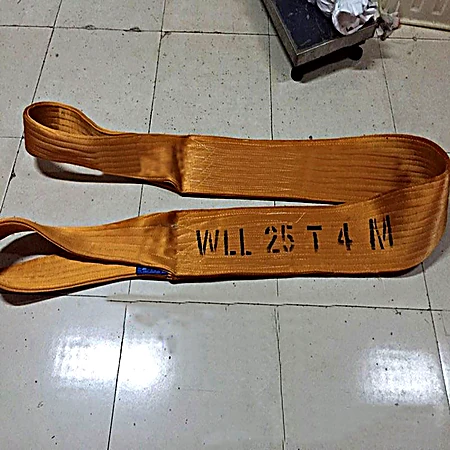
| Marking | Printed along the webbing and on a sewn label: WLL, lengte, mode, standard, manufacturer, date of manufacture |
| Standard | EN 1492-1; other national standards made on request |
| Sertifisering | CE / GS / JIS; ISO 9001; CNAS laboratory test report |
| Pasmaak | OEM / ODM — width, lengte, ply, colour, printed webbing, own label and packing |
Working load limit by width and ply
Two numbers set the capacity of a flat web sling: the width of the band and the number of plies sewn into it. The figures below are for one leg hanging vertically, which is the figure printed on the sling; the arrangement you lift in changes it, and the factors are in the next table.
| Webbing width | Duplex (2-ply) | Triplex (3-ply) | Quadplex (4-ply) | Typical duty |
|---|---|---|---|---|
| 100 mm | 8 t | 12 t | 16 t | Steel units, concrete elements, machine parts |
| 150 mm | 12 t | 18 t | 24 t | Long and heavy fabricated loads, pipe and tube bundles |
| 200 mm | 16 t | 24 t | 32 t | Heavy fabricated steel, castings, large moulds |
| 240 mm | 20 t | 30 t | 40 t | Very heavy lifts, large weldments, shipyard and port duty |
| 300 mm | 24 t | 36 t | 48 t | The heaviest standard range; large fabrications and heavy plant |
Mode factors — the figure changes with the hitch
The working load limit printed on a heavy duty eye & eye flat web sling applies to the vertical mode. Every other arrangement is that figure multiplied by the factor below, measured from the vertical. A choked sling carries less than the same sling used vertically, and a spread basket carries more; the label always overrides the table.
| Mode | How the sling is hitched | Factor | Worked example, 16 t 4-ply sling |
|---|---|---|---|
| Vertical | One eye on the hook, load directly below | 1.0 | 16 t |
| Choked | Sling passes around the load and through its own eye | 0.8 | 12.8 t |
| Basket, 0–45° | Sling under the load, both eyes on the hook, legs close together | 2.0 | 32 t |
| Basket, 45–60° | As above, with the legs spread wider | 1.4 | 22.4 t |
| Two legs, 0–45° | Two slings to one hook, legs near vertical | 1.4 | — |
| Two legs, 45–60° | Two slings to one hook, legs spread | 1.0 | — |
Eye reinforcement and edge protection
The eye is where a heavy duty sling wears out first, so it is specified deliberately on this build rather than accepted by default. A reinforced eye carries extra stitching at the root, where the load concentrates. A wear pad inside the eye takes the polish of hook and shackle contact instead of the load-bearing webbing. Where the load has a sharp edge, a sleeve over the body is part of the sling, not an accessory added later — the same discipline that applies to our steel pipe lifting strap. The trade-off is honest: a metal end fitting is easier to inspect and can be replaced, but it marks a load and it can corrode. A sewn eye cannot do either.
Where a heavy duty eye & eye flat web sling is used
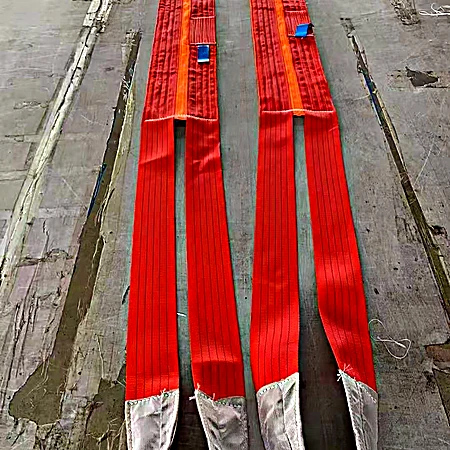
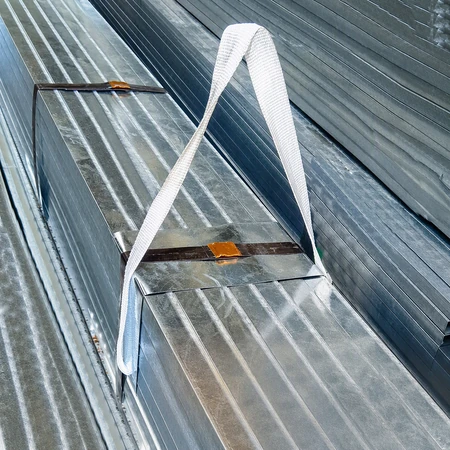
This is the sling for steel plate and sections, concrete elements, pipe and tube bundles, large moulds, castings, weldments and heavy plant — anywhere the load is heavy and the surface is worth protecting. Because both ends carry an eye, the same sling works vertically, in a basket and in a choke hitch, which makes it the flexible choice for a mixed workload. Where the sling has to reach around abrasive edges it is paired with a protective sleeve; where the lift is two or four legged it sits under a lifting spreader beam rather than directly on the hook.
Related slings in the range
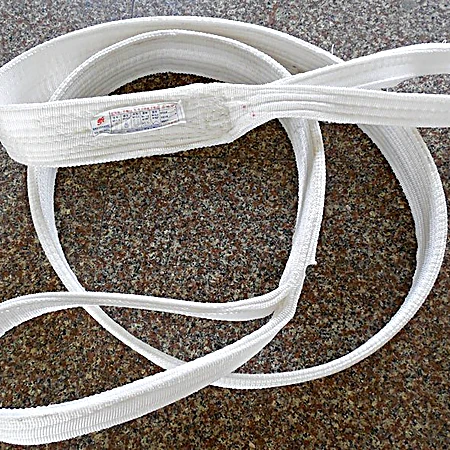
A heavy duty eye & eye sling is one shape in a family. For the full range see flat webbing slings, the general-purpose eye and eye webbing slings with flat or twisted eyes, the heavy eye webbing sling for the largest eyes, and the wide body lifting webbing sling where the pressure on the load has to be spread further still. Where there is no eye at all, the endless flat webbing sling and the ronde stroppe cover the same duties in a different form; where the load is hot, the high temperature webbing sling and the aramid webbing sling are the right answers, and for loose cargo the cargo lifting nets do a job no sling can.
Frequently asked questions
How heavy a load can a heavy duty eye & eye flat web sling lift?
Standard builds run from 5 t to 48 t per leg in the vertical mode, across 100 mm aan 300 mm widths in 2, 3 and 4-ply webbing. Above 48 t the sling is built to order. The figure that applies is always the one on the label, adjusted by the mode factor for the hitch you use.
Why choose 4-ply over 2-ply webbing?
More plies mean more capacity at the same width and a longer working life, because the outer ply takes the abrasion and the inner plies carry the load. Choose 4-ply for very heavy or very repetitive lifts; 2-ply where the load is moderate and the sling is not dragged over abrasive ground.
Will it mark a painted or machined surface?
No. There is no metal in the sling and the band spreads the load across its full width, which is the reason a flat web sling is chosen over a wire rope sling wherever a finished surface has to arrive undamaged.
What length should I order?
Quote both figures: the overall length (L, eye tip to eye tip) and the effective length (EL, the reach in service from bearing point to bearing point). More slings are replaced for a length misunderstanding than for any other reason, so state which one you need and we will confirm it on the quotation.
Can one sling be used for lifting and for lashing?
Not as the same article. Lifting is rated on a working load limit, restraint is rated on a lashing capacity, and the two are marked differently. Buy the sling as a lifting sling and the lashing as a lashing.
Order a heavy duty eye & eye flat web sling
Send us the load, the working load limit you need per hitch, the arrangement (vertical, basket or choked) and the environment it works in. We will confirm the width, ply, lengte, eye reinforcement, protection and marking, and quote before the band is woven. Ask about the lifting devices and fittings that go with it, or browse the rest of the lifting sling range.