

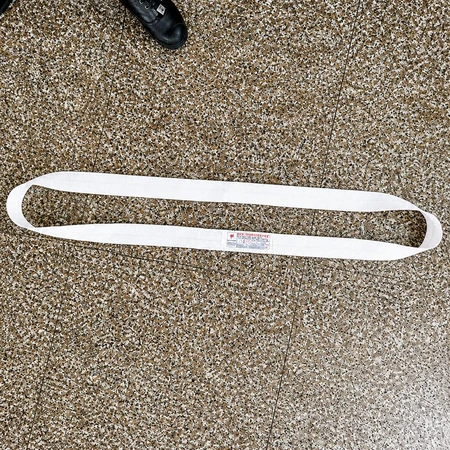
Lift sling rigging company produce One-Way Webbing Sling,One Way Endless Webbing Slings,Polyester Single Trip One Way endless webbing slings.
One Way Webbing Sling
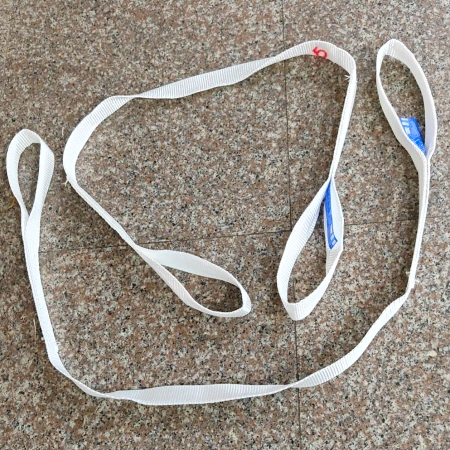
A eenrigting slinger is a rated polyester sling bought for one journey: it is fitted to the load, travels with it and is written off against that job instead of being returned to a sling store. This page covers the closed eindelose lus form — the shape specified for pipe, tube and bundling work, because a loop wraps a cylinder instead of hooking it. Standaard reeks: 1 t aan 12 t, bandwydte 25 mm aan 300 mm, veiligheidsfaktor 5:1, 6:1 of 7:1, lus lengte 0.5 m aan 100 m, marked to BS EN 1492-1.
On this page
What “one way” decides, en wat dit nie doen nie
The phrase describes the commercial life of the article, not its quality. A one way sling is manufactured, bewys gelaai, colour coded and labelled to the same standard as a sling that will be inspected for years; the difference is that it leaves the store once and does not come back.
Three practical consequences follow. Dit is uitgereik met die vrag, so it becomes a line on the packing list rather than an item in a sling register. Dit is inspected once, op die punt van kwessie, while a fault can still be replaced from the same consignment. And its print is its whole record: werkladingslimiet, lengte, factor and batch are the only traceability the band will ever carry, so the marking has to survive a lorry, a container and a loading bay — not just the production line.
What it does not change is the engineering. A narrow band or a lower factor chosen because “it is only going one way” is not a saving; dit is 'n ongegradeerde marge wat uit die hysbak geneem word. The figure that applies is the figure printed on the band, for the arrangement actually used. Buyers who need the returnable version of the same loop should read the enkellaagse eindelose plat slinger page instead.
Why a closed loop is the right form for pipe, tube and bundles
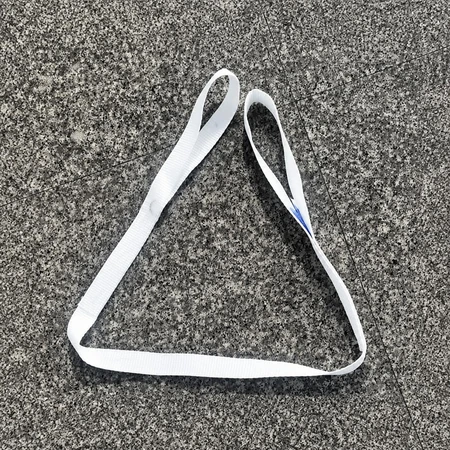
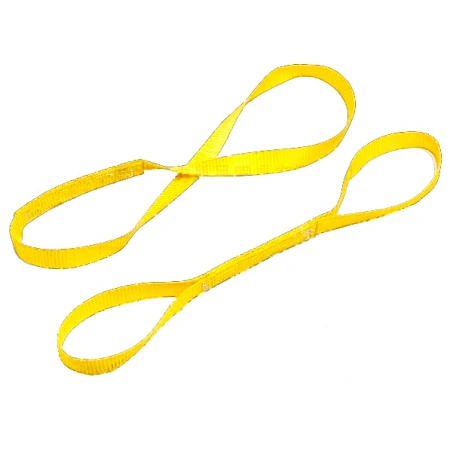
An endless webbing sling is a band joined to itself. There is no eye to line up against a machined pipe end, no stitching stack at the bearing point and no shackle, hook or thimble anywhere on the article. On round loads that single property does most of the work.
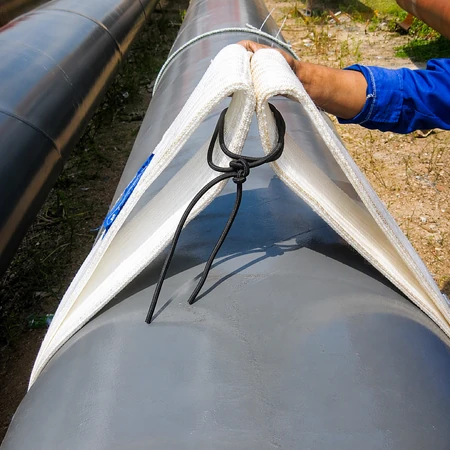
- It cannot mark a coating. Galvanising, fusion bonded epoxy, three layer PE and paint are all damaged by the same things: a steel edge, a sliding hook and point pressure. A woven polyester face addresses all three. Nothing metallic contacts the pipe, and the load never slides against a fitting.
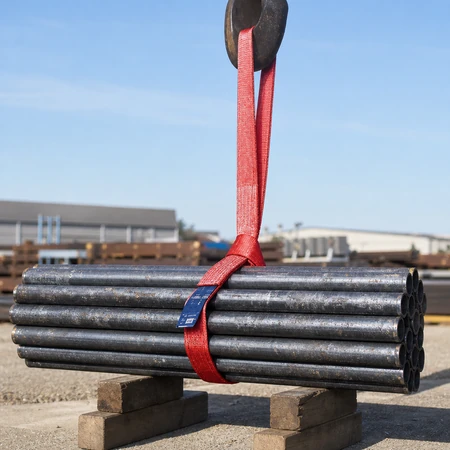
- The choke holds itself. Passed round the pipe and back through the loop, the band tightens as the load rises. On a cylinder the contact line is a full wrap rather than two point contacts, which is why a loop resists slipping along the axis and does not walk towards the pipe end during a pick.
- The load stays centred. Because the band wraps symmetrically, the pick point sits over the centre of gravity of a joint or bundle rather than off one side — the usual cause of a tilted, eccentric lift and of one sling taking more than its share.
- Pressure is spread by width. Thin wall PVC, PE and stainless tube dent under a narrow band. A 100–200 mm face turns a point load into a low pressure band, which is the single most effective protection on a soft or thin walled pipe.
- Nothing to lose and nothing to thread. A band with end fittings can arrive with the fittings gone. A loop is one piece of webbing: it is either there or it is not, and the person re-slinging at the far end needs no rigging plan to use it.
Where a one way webbing sling is used
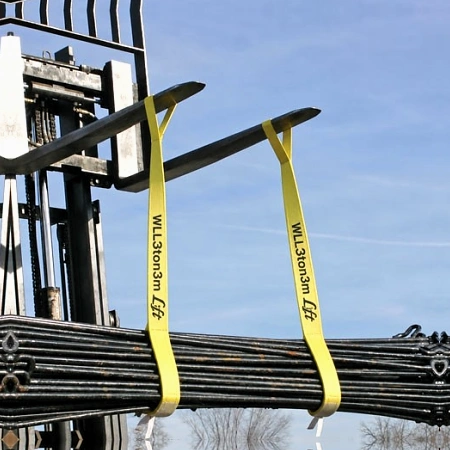
The loop is chosen where the load is toegedraai rather than hooked, and where the surface matters as much as the tonnage. On a joint lifted on its own, one loop goes round the pipe near each end and the two legs meet at the hook; on a bundle, one loop per pick position is choked round the pack. The applications below are the ones this range is most often bought for, and each one puts a different line on the enquiry.
| Laai | Why the loop suits it | What to state on the order |
|---|---|---|
| Staalpyp en buis, single joints or bundles | A round section is wrapped, not hooked; the choke grips and the band cannot slide along the pipe. | Buite deursnee, muur, joint mass or bundle mass, spacing of the two pick positions. |
| PVC and PE pipe | Thin walls dent under point pressure; a wide soft face spreads the load and leaves no witness mark. | Deursnee, wall thickness, mass per joint, whether a surface mark is a rejection. |
| Anti-corrosion pipe (3PE, FBE, tape wrap) | No metal and no sliding contact, so the coating survives the lift and the inspection at destination. | Coating type, whether coated ends are handled, and any requirement for a sleeve. |
| Stainless and copper tube | Sag, expensive and unforgiving of a burr; a polyester face is softer than the load. | Voltooi (meul, polished), tube diameter, girth at each pick. |
| Rebar bundles and steel mesh | Cut wire and mesh edges attack a narrow band; a wide loop carries the bundle and resists abrasion. | Bundle mass, number of ties per bundle, whether edge sleeves are needed. |
| Profiles, sections and sheet packs | A sharp arris is a blade against webbing; width and edge protection decide the life of the band. | Afdeling, stapel hoogte, rand toestand, band direction. |
| Logs, timber and timber packs | The arris prints into dressed stock and cuts the weave on a narrow band; a loop spreads the pressure. | Pack mass as it travels, girth at the picks, whether a compression mark matters. |
| Machinery and painted assemblies | Nothing metallic touches the load at either end, which on a painted or ground surface is the reason to buy it. | Mis, swaartepunt, lifting points, surface finish. |
Specifications of the one way webbing sling
The figures below describe the standard build. Breedte is nie 'n vrye keuse nie: it follows from the working load limit and from the safety factor, so the same tonnage appears at three widths. Lus lengte, laag, colour and print are made to the order.
| Produk | One way webbing sling, eindelose lus (omsendbrief) vorm; also supplied with formed eyes as a disposable webbing sling one eye |
|---|---|
| Vorm | Geslote lus, plat geweef, band joined to itself — no eye, no end, no metal fitting |
| Bou | Single ply standard; double ply for a higher figure at the same width or a stiffer bearing face |
| Vesel | High tenacity polyester band (PES); nylon (PA) for shock loads and polypropylene on request |
| Web dikte | 4 mm standaard (3–10 mm across the range) |
| Werkladingslimiet | 1 t - 12 t single ply; 2 t - 24 t dubbellaag |
| Bandwydte | 25 mm – 300 mm, set by the working load limit and the safety factor |
| Veiligheid faktor | 5:1 / 6:1 / 7:1, by bestelling gekies |
| Lus lengte | 0.5 m - 100 m in one continuous loop; minimum length rises with width |
| Verlenging | ≤ 7 % by die werkslasgrens (poliëster) |
| Werk temperatuur | −40 °C tot +100 °C deurlopend; polyester melts at about 258 °C, so sparks and hot work need a sleeve |
| Kleur | BS EN 1492-1 capacity colour — 1 t violet, 2 t groen, 3 t geel, 4 t grys, 5 t rooi, 6 t bruin, 8 t blou, 10 t oranje; spesiale kleure en gedrukte logo's op OEM-bestellings |
| Etiket | Werkladingslimiet, lus lengte, veiligheidsfaktor, bondelnommer, customer reference; blue or white label |
| Standaarde | BS EN 1492-1; ASME B30.9 for the 5:1 bou; other market standards to order |
| Verpakking | Bundled, cartoned or palletised, labelled per pack and listed on the packing list against the printed reference |
| HS kode | 630790 |
Choosing the size: the figure from the pick, the width from the surface
Two decisions are made separately and in this order. Die werkladingslimiet comes from what one pick has to carry, divided by the mode factor of the hitch — not from the mass of the load as weighed. Die breedte then comes from the surface being wrapped: a coated pipe and a painted machine at the same tonnage do not want the same band.
| Load at one pick | Werkladingslimiet | Breedte (5:1 / 7:1) | Tipiese gebruik |
|---|---|---|---|
| Tot 0.8 t | 1 t | 25 / 30 mm | Klein boor buis, single light sections, tooling |
| 0.8 – 1.6 t | 2 t | 50 / 60 mm | Pipe to 6″ in single joints, small bundles |
| 1.6 – 2.4 t | 3 t | 75 / 90 mm | Pipe to 10″, rebar bundles, hout pakke |
| 2.4 – 3.2 t | 4 t | 100 / 120 mm | Coated pipe 12–16″, vel pakkies |
| 3.2 – 4.0 t | 5 t | 125 / 150 mm | Heavy wall pipe, masjinerie, klip |
| 4.0 – 4.8 t | 6 t | 150 / 180 mm | Pipe bundles, strukturele afdelings |
| 4.8 – 6.4 t | 8 t | 200 / 240 mm | Large bundles, spoele, log packs |
| 6.4 – 8.0 t | 10 t | 250 / 300 mm | Export pipe bundles, heavy fabricated items |
| 8.0 – 9.6 t | 12 t | 300 / 300 mm | Maximum single ply; go to double ply above this |
Lengte: the two conventions, and why the mistake is expensive here
A loop has no ends to measure between, so the trade quotes the same article two ways. The two figures differ by about a factor of two, and on a one trip band the error surfaces at the far end — in front of a customer, met geen tweede band om in te ruil nie.
| Jy skryf | Dit beteken | Wanneer om dit te gebruik |
|---|---|---|
| Lus omtrek 4.0 m | Een volle draai om die vrag, gemeet om die geslote lus | Die band word beveel om 'n bekende omtrek toe te draai |
| Band lengte 2.0 m, plat gelê | The webbing cut length before joining — half the circumference | Die band word geprys en per meter gesny |
| Omtrek by die kies 1.6 m, twee keuses | Die afmeting van die vrag self, plus the number of bands | Safest form on a first order: dit het geen konvensie nodig nie |
What the same loop carries in each hitch
The figure on the label describes the vertical arrangement only. All three hitches are rigged without any change to the article, which is why the arrangement has to be stated before the width is fixed.
| Reëling | Faktor | A 5 t lus gee | Waar dit gebruik word |
|---|---|---|---|
| Vertical — loop hangs, vrag aan die een kant | 1.0 | 5.0 t | Single point pick, hook through the loop |
| Choked — round the load and back through itself | 0.8 | 4.0 t | Pyp, buis, poles, tromme, bundels |
| Mandjie, bene 0–45° | 2.0 | 10.0 t | Under a bundle with both legs carrying |
| Mandjie, bene 45–60° | 1.4 | 7.0 t | Wide bundles, short sling legs |
Die choke is die rangskikking waarvoor 'n lus gekoop word, en dit is ook die een wat kos 20 % of the printed figure. A 4.5 t pypbondel verstik aan a 5 t lus is 'n oorlading, not a margin — the answer is the next width up, not a longer band.
Coating and surface compatibility
| Oppervlakte | Risk in the lift | Sling measure |
|---|---|---|
| Hot dip galvanised pipe | Zinc layer rubbed through by sliding hardware; white rust at a scored line | Eindelose lus, geen toebehore nie, 100 mm band or wider, dry and grit free |
| 3PE / FBE anti-corrosion pipe | Point pressure and edge cuts at the coating; repairs are costly at destination | Wide soft face, padded protector at the contact, choke without a wire rope stinger |
| PVC and PE pipe | Denting and ovality under a narrow band, especially in warm weather | 150–200 mm band, twee keuses, basket rather than a single choke on long joints |
| Stainless tube | Iron contamination and scratching from contact with steel fittings | Dedicated synthetic sling, geen metaalkontak nie, skoon berging voor uitreiking |
| Copper tube | Brinelling and burrs from hard contact | Loop only, band width matched to tube diameter |
| Painted or machined assemblies | Print-through and paint damage at the sling contact | Soft loop, edge sleeves, protector where the band crosses an arris |
Nasien, label and what it has to survive
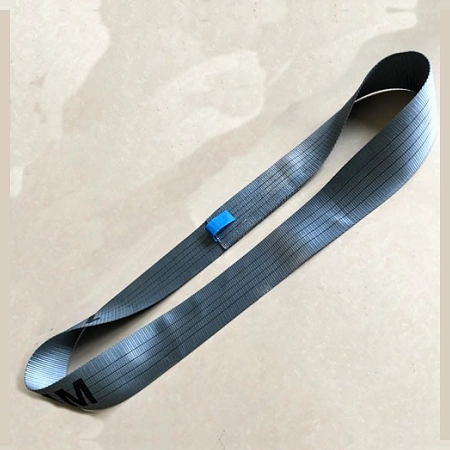
On a single trip article the print is the record, so the marking is a specification line rather than a detail. Four things belong on the label: the working load limit, the loop length with its convention, die veiligheidsfaktor, and the reference the despatch actually uses — a batch, 'n paknommer, 'n bestelnommer of jou eie onderdeelnommer. That reference is what ties the band on a quay to the line on a packing list in an office.
- Leesbaar na die reis, nie na produksie nie. Small, low contrast print on a face that enters the choke will not be read at the far end.
- Kleur as 'n tweede kanaal. Een kleur per pak tipe, per customer or per tonnage lets a container of identical bands be sorted at a glance.
- Printed to your string. The label can carry your reference in the exact case and format you send, en die bande kan in 'n krat gepak word, vasgemaak aan 'n stilstaande of in 'n bondel vasgeplak, gemerk per pak.
The single inspection, and what it looks at
A one trip band is checked once, ter sprake, while a fault can still be replaced from the same consignment. Look at four things, in hierdie volgorde: die weefsel waar dit die vrag ontmoet (snye, skuur, 'n geglasuurde of geknyp gesig), die verbinding waar die lus toemaak, the label — an unreadable figure cannot be matched to the pack it was cut for — and what the band has been lying in. Gruis, smeer, olie en staande water beweeg in die kontak, and a clean band is the cheapest protection available.
Do
- State the hitch, the girth and the mass per pick
- Add edge protection at a cut sheet, mesh or arris
- Keep the band dry, clean and off the ground before issue
- Retire the band at the destination, not back to a rack
Do not
- Shorten a sling with a knot or join two by knotting
- Repair webbing by stitching, sweis of verhitting
- Drag a loop over a cut edge or across the ground
- Re-issue a band that has done a journey
Protect the band from sharp edges, warm oppervlaktes en sweisspatsels met 'n huls of 'n opgestopte beskermer. Hierbo 100 °C, or where sparks are present, polyester is the wrong fibre and an eindelose ronde slinger with a heat resistant cover is the article to discuss.
One way or returnable: the arithmetic
The commercial case is simple and it is arithmetic, not preference. A one way band costs less per unit than a returnable sling and carries no return freight, geen inspeksieregister nie, no repair and no loss write-off — but it has to be counted correctly, because nothing comes back to cover a shortfall. Tel uit die pak, nie uit die tonnemaat nie: twee keuses per pak is twee bande, a four point lift is four, ninety packs at two picks is 180 bands. Add two to five per cent for the band cut while the pack is made up, so 'n tekort word 'n reël op die bestelling in plaas van 'n vertraging by die beskuldigdebank.
Where the same slings are used week after week in one yard, a returnable article inspected between lifts is the cheaper order over a year. Where the sling leaves with the load — export packing, one off shipments, work that ends on a customer’s site, or a coated pipe consignment that is re-slung at the far end — the one way loop is the right purchase. Where the whole consignment travels as a netted unit instead of being slung joint by joint, a vrag optel net is the article to price against it. The form with eyes at both ends, for loads that are hooked rather than wrapped, is op die weggooibare eenrigting-strop bladsy; the wider family is on the eenmalige stroppe en single use lifting slings endless loop bladsye.
What to send with the enquiry
Six lines are enough to quote a made to order band, and they remove every ambiguity that shows up later at the load:
- The load — pipe diameter and wall, bundle mass, or the finished item.
- The pick positions — how many, and how far apart.
- The arrangement — vertical, verstik of mandjie, and the angle if basket.
- The girth at each pick, or the loop length with its convention named.
- The safety factor your market works to, and the standard to mark to.
- The reference to print, and the quantity per pack.
Request a quotation for one way webbing slings
Stuur die vrag, die kiesposisies, the girth and the factor. Ons kom terug met die breedte, die luslengte, the finished weight and the marking — on a drawing, voordat die band gesny word.
Send your sling specification · Telephone / WeChat +86 180 6600 2268 · 702461526@qq.com
Lifute Nywerheidspark, Taizhou Stad, Jiangsu Provinsie, China · HS code 630790
Gereelde vrae
What is a one way webbing sling?
A rated polyester webbing sling supplied for a single journey. Dit reis saam met die vrag, is inspected once at the point of issue and is not recovered or re-issued. The endless form is a closed loop of flat woven polyester with no eye and no metal fitting, which is why it is the form chosen for pipe, tube and bundles.
Is a one way sling weaker than a reusable one?
Nee. Die vesel, weef, breedte, veiligheidsfaktor, working load limit and marking are specified exactly as for a returnable sling. Die woord beskryf die reis, not the grade, so a lower factor or a narrower band is not a saving on a single trip article.
Will a webbing sling scratch galvanised or anti-corrosion pipe?
The band is synthetic fibre and no shackle, hook or thimble touches the load when an endless loop is used, so there is nothing to cut or gouge a zinc, epoxy or polyethylene coating. Breedte is die beskermingsmaatreël: hoe wyer die band, the lower the pressure at the contact.
How is the length of an endless webbing sling measured?
Two conventions are used and they differ by about a factor of two: die omtrek van die geslote lus, en die lengte van die band plat gelê voordat dit saamgevoeg word. Name the convention with the figure, or give the girth of the pipe or bundle the loop must go round.
Can the same loop be used in a choker hitch?
Ja, and a closed loop is the natural form for a choke on pipe, tube and bundles. Die verstikte figuur is 0.8 of the vertical working load limit, dus a 5 t loop chokes 4 t. Select the width for the arrangement actually used.
Which safety factor should I order, 5:1, 6:1 of 7:1?
7:1 is the usual European figure for flat woven webbing slings to BS EN 1492-1, 5:1 is the customary North American figure under ASME B30.9, en 6:1 sit tussen hulle. Dieselfde tonnemaat teen 'n ander faktor is 'n ander artikel met 'n ander breedte, dus die faktor hoort by die ondersoek.
Kan die band gedruk word met ons eie verwysing?
Ja. Werkladingslimiet, lus lengte, veiligheidsfaktor, batch and your own pack, order or part number can be printed as produced, in the exact string you send, so a band at the far end can be tied back to a line on the packing list.