

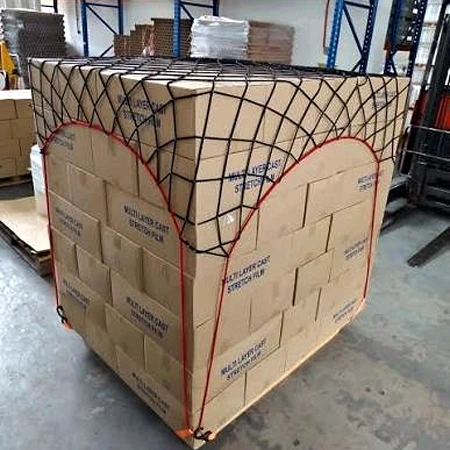
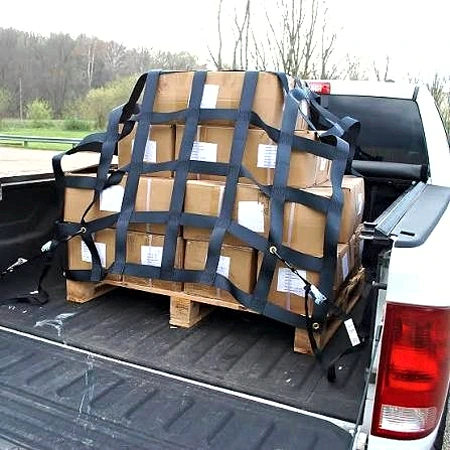
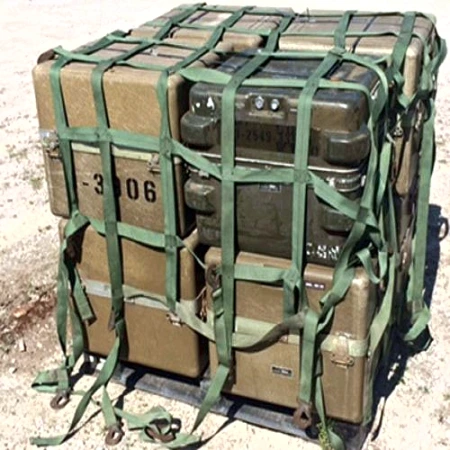
Lift sling rigging maatskappy produseer Cargo Securing Net,Laai Beveiligingsnet,Klein gaas vrag beveiligingsnet,Houer beveiligingsnet,Vrag veilige bandnet.
Vragbeveiligingsnet
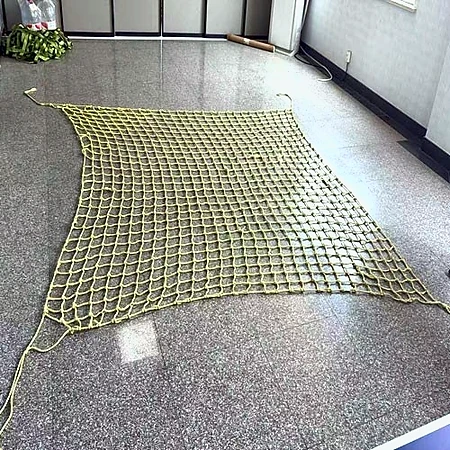
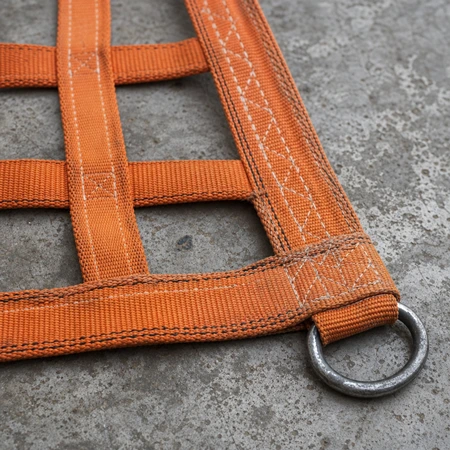
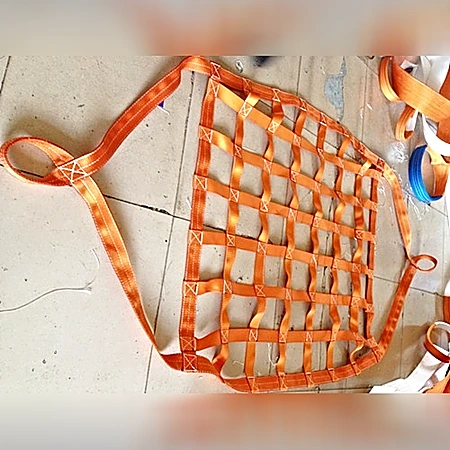
A cargo securing net is a flat-belt restraint net laid over a load and tensioned down to the deck, so that the cargo cannot slide, rock or topple on the way. The belts are woven from high-tenacity polyester into an open lattice, the border is folded and double-stitched, and the edge carries rated attachment points that are pulled down with ratchet tensioners until the load is pressed onto the vehicle or container floor.
The distinction that matters on this product is duty, not appearance. A cargo securing net restrains; it does not lift. Its label carries a lashing capacity (LC) and a standard tension force (STF) in daN, the arrangement is calculated to EN 12195-1 and the belts are type-tested to EN 12195-2 – not to a lifting working load limit. We weave the belts in our own mill in Taizhou, so net size, gaas, belt width, fittings and markings are set to your load, your vehicle and your anchor points.
- Restraint rating, nie 'n stygende gradering nie – LC and STF marked in daN, calculated to EN 12195-1, belts type-tested to EN 12195-2.
- Flat high-tenacity polyester belts – 25 mm aan 100 mm, single or duplex, UV stabilised and rot-proof.
- Sized to the load or the aperture – cover nets, container doorway nets, partition nets and bag form, all made to order.
- Rated fittings and tensioners – ratchets, hake, D-rings and lashing points, with anti-slip mats where the deck friction is low.
- CE en GS gesertifiseer – geweef, gestik, marked and tested in one plant, met ISO 9001, CNAS and DNV behind it.

Restraint is not lifting – and the label says which one you have
The two products look alike, are made from the same belt and are often bought by the same fleet. Hulle is nie uitruilbaar nie, and the difference is not a formality: one is sized so a load cannot move, the other is sized so a load cannot fall. Using a restraint net on a crane hook, or a lifting net as a tensioned tie-down, is a safety failure rather than a paperwork problem.
Tafel 1 – Why a securing rating and a lifting rating are not interchangeable.
| Vergelykingspunt | Vrag beveiligingsnet (hierdie bladsy) | Hysnet |
|---|---|---|
| Wat dit doen | Beperk 'n vrag wat op die voertuig bly | Dra die volle gewig van 'n vrag in die lug |
| Regeer deur | IN 12195-1 (berekening van beveiligingskragte) en EN 12195-2 (bandbande) | Opheffing standaarde, with webbing rated on the EN 1492-1 basis |
| Gegradeer in | Sjor kapasiteit (LC) en standaard spanningskrag (STF), in daN | Werkladingslimiet (WLL), in ton |
| How it is sized | Sized to resist the acceleration and friction case for the journey | Grootte met 'n 5:1, 6:1 of 7:1 faktor en bewys getoets per slinger |
| How it is tested | Belt and tensioner type-tested to EN 12195-2 | Every sling break-tested on our own 1000 t masjien |
| Hoe dit misluk | The load moves – a road accident | The sling breaks – a dropped load |
If the requirement is to lift – a pallet onto a roof, a bag into a hold – the right product is a lifting net: die kraanpalletvragnet, die poliëster-hys-hysnet of die swaardiens nylon vragnet slinger. If the requirement is to keep a load still from the loading bay to the delivery point, this page is the right one.
The forces the net has to answer for
A load on a moving vehicle is pushed in three directions, and each one is a design case rather than an accident. The accelerations below are the ones EN 12195-1 uses for road transport; other modes and national rules differ, which is why we ask where the load is travelling before we size the net.
Tafel 2 – Design accelerations for road transport and what resists each one.
| Direction | Design acceleration | What resists it |
|---|---|---|
| Forward (braking) | 0.8 g | Blocking or a headboard first, then direct lashings to the front; friction contributes |
| Rearward (acceleration) | 0.5 g | Rear lashings and a tailboard; the net’s rear edge lines |
| Sywaarts (cornering) | 0.5 g | Side lashings, containment by the lattice, and friction from the pre-tension |
| Vertikaal | Not a road design case | Held down by pre-tension and containment; a net reduces bounce but is not a substitute for blocking |
The practical consequence is that a net alone rarely carries the whole case. Blocking against a headboard does more for the braking case than any strap, and a net laid over the top does the rest. A good securing arrangement is a combination, and we will say so when a net is the wrong answer for your load.
Hoe 'n platgordelnet 'n vrag hou
'n Beveiligingsnet werk deur drie meganismes gelyktydig. Which one dominates depends on how the net is fitted, and that is decided at the vehicle rather than at the factory.
Tafel 3 – The three mechanisms a securing net uses.
| Meganisme | Hoe dit werk | What it depends on |
|---|---|---|
| Wrywing (vasbind) | Die gespanne net druk die vrag op die dek, en wrywing tussen vrag en dek weerstaan gly. This is the main effect of a cover net | 'n Skoon, dry deck or anti-slip mats. Sonder wrywing beperk dieselfde net veel minder |
| Inperking | Die traliewerk stop fisies dat die las versprei, rocking, or throwing individual items out | A mesh fine enough for the smallest item, and a net fitted tight rather than draped |
| Direct lashing | Where the edge belts run down to rated points on the vehicle, die gordel self dra die vashoukrag | Certified anchor points on the vehicle – never a random protrusion or a load’s own packaging |
Two numbers decide whether the arrangement works, and both are usually ignored. The first is the angle: a tie-down belt is most effective between 75 en 90 grade na die dek, and its effective capacity follows LC_eff = LC × sin α. By 30 degrees you keep roughly half the belt’s rating, so a net pulled down almost flat looks tidy and holds very little. The second is friction: the coefficient between a steel load and a steel deck is about 0.1 aan 0.2, steel on timber about 0.2 aan 0.3, timber on timber about 0.3 aan 0.4, and a good anti-slip mat takes a pallet on a deck to about 0.5 aan 0.6. Nat, oily or icy surfaces take all of these figures down, which is why the same net restrains very different loads on two different days.
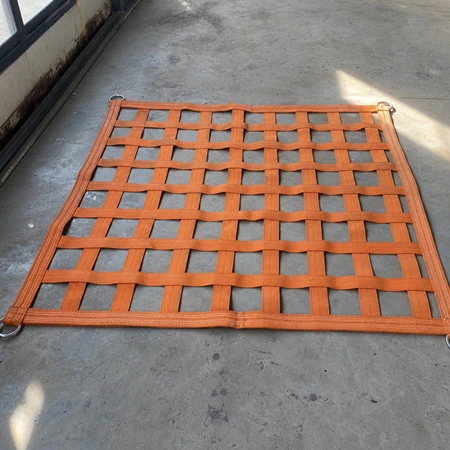
Tegniese parameters
Die syfers hieronder dek die standaard beveiligingsreeks. Gordel, gaas, netto grootte, randtoebehore en spanners word alles op bestelling gemaak, behandel hierdie tabel dus as die beginpunt vir 'n kwotasie eerder as 'n vaste katalogus.
Tafel 4 – Vrag beveiligingsnet: tegniese parameters.
| Parameter | Spesifikasie |
|---|---|
| Produk tipe | Vrag beveiligingsnet (laai net) – cover net, partition net, container doorway net or bag form. Nie 'n opteltoestel nie |
| Belt material | 100 % hoë-sterkte poliëster (PET); hoë-sterkte nylon op aanvraag |
| Bandbreedte | 25 / 35 / 50 / 75 / 100 mm |
| Belt construction | Enkellaag of dupleks, woven selvedge, not a cut edge |
| Belt thickness | 1.8 mm – 4.0 mm afhangende van breedte en laetelling |
| Gaas opening | 100 × 100 mm standaard; 50 mm – 300 mm op bestelling gemaak |
| Netto grootte | Gemaak volgens die lasvoetspoor, die voertuigbed, of die houer of deuropening |
| Sjor kapasiteit (LC) | Oor 750 daN on a 25 mm belt to about 5,000 daN on a 100 mm duplex belt, marked per net |
| Voorspanning (STF) | 250 – 500 daN depending on the tensioner supplied; op die etiket gemerk |
| Standaard basis | IN 12195-1 for the securing calculation; IN 12195-2 for the webbing lashing |
| Grens | Gevou en dubbelstiksel; by elke aanhegtingspunt versterk |
| Toebehore | Ratelspanners, hake, D-ringe, cam buckles and lashing points, graad 80 steel where steel is used |
| Kleur | Orange for high visibility as standard; blou, groen, black or a custom colour |
| Behandeling | UV gestabiliseer, anti-veroudering, skuur- en skeurbestand, rot-proof |
| Werk temperatuur | -40 °C tot +100 °C |
| Sertifisering | CE, GS, ISO 9001, JIS on request; CNAS laboratorium; DNV |
| Pasmaak | OEM / ODM grootte, kleur, printed belt, etiket, logo and packing |
| HS kode | 6307.90 – nets and netting of textile materials |
Standaard groottes, mesh and lashing capacity
A securing net is sized to the load it covers or the aperture it closes, never to a tonnage. The load has to be fully covered, and the border has to land on the deck or on the anchor points instead of hanging in mid-air, because an unsupported edge is an edge that can be pulled sideways.
Tafel 5 – Standard securing net sizes, with the belt and capacity that normally go with them.
| Netto grootte (L × W) | Maas | Gordel | LC per edge line | Tipiese gebruik |
|---|---|---|---|---|
| 1.2 × 1.2 m (4 × 4 ft) | 100 mm | 35 – 50 mm | 1,000 – 2,000 En | Single pallet in a van or light truck |
| 2.5 × 1.2 m (8 × 4 ft) | 100 mm | 50 mm | 2,000 En | Two pallets abreast in a van or curtain-sider |
| 2.5 × 2.5 m | 100 mm | 50 mm | 2,000 En | Platbedvragte, masjinerie, mixed cargo |
| 5.0 × 2.5 m | 100 – 150 mm | 50 – 75 mm | 2,000 – 3,500 En | Vollengte platbak en sleepwavragte |
| 2.4 × 2.6 m (houer) | 100 mm | 75 mm | 3,500 En | Container doorway net, load held back from the doors |
| 1.5 × 1.5 m bag form | 50 – 100 mm | 50 mm | 2,000 En | Loose or bagged goods that would spread on the deck |
| Gemaak om te teken | 50 – 300 mm | 25 – 100 mm | To calculation | Enige voetspoor, aperture or vehicle bed |
The capacity column is the restraint available per edge line, not a lifting limit. The number of edge lines, their angle and the friction under the load decide what the arrangement actually restrains.
Four forms of securing net
The same lattice is supplied in four arrangements, and choosing the right one is most of the job. Die toebehore verskil tussen hulle; die selfbeheersingsbeginsel nie.
Tafel 6 – Bedekking, partition, container and bag forms.
| Vorm | Hoe dit gepas is | Word gebruik wanneer |
|---|---|---|
| Deknet | Spread over the load and tensioned down to the deck or to the vehicle’s rated points | Platbed, curtain-sider and container loads that must not move in any direction – the most common arrangement |
| Partition net | Fixed upright across the vehicle body and tensioned against its own frame | Separating two loads in one vehicle, or holding cargo away from a bulkhead |
| Container doorway net | Fitted across the door aperture and hooked to the container’s own rings | Stopping cargo migrating to the doors during the journey, so the container is safe to open |
| Sakvorm | Closed at the bottom, with the cargo sitting inside the lattice | Loose or bagged goods that would otherwise spread across the deck |
Toebehore, tensioners and anti-slip
A securing net is only as good as the tensioner that pre-tensions it and the anchor point it pulls against. These are the parts that get specified last and fail first.
Tafel 7 – Toebehore en spanners.
| Gepas | Gebruik met | Let wel |
|---|---|---|
| Ratelspanning | Deknet, sakvorm | Stel die voorspanning (STF). A ratchet that cannot reach the marked STF makes the net ineffective, whatever its LC |
| Cam gesp | Ligte diens | Faster than a ratchet but reaches a much lower pre-tension – for light loads only |
| Hakies en D-ringe | Enige reëling | The link between net and anchor point; graad 80 staal waar 'n staal passtuk gebruik word |
| Vassnypunte | Deknet | Rated anchor points in the vehicle structure – the restraint force has to go somewhere rated |
| Anti-slip mat | Wrywingsbeperking | Raises the friction coefficient under the load; usually the single most effective addition on a smooth deck |
| Beskermingshuls | Skerprandvragte | Fits over the belt at the contact point; die goedkoopste manier om netto lewe te verleng |
| Herstelstel | Fleet maintenance | Matching belt, stikdraad en 'n ekstra spanner |
Nasien, colour and identification
A securing net is checked by the driver before every trip and by an inspector at the roadside, so the marking has to be readable at a distance and has to survive being dragged over a deck.
- Lashing capacity and standard tension force printed along the belt in daN – the units load securing is actually calculated in.
- Net size and date of manufacture printed as well, so the net can be matched to the vehicle and its age judged on the spot.
- A sewn capacity label in addition to the print, dus stem die net en sy papierwerk altyd saam.
- Orange as the standard high-visibility colour, with blue, groen, black or a house colour for fleet identification.
- OEM orders can carry your brand, warning text or certificate number printed on the belt.
- Nets ship folded into a bag or a crate – a fleet order takes a fraction of the space of the same number of loose straps.
Toets, certification and traceability
- Forty years of lifting equipment manufacturing – gestig in 1985 in Taizhou, Jiangsu, met meer as 200 werknemers.
- Belts woven in our own mill, so breedte, layer count and colour are under our control rather than bought in.
- Webbing strength-tested on our own 1000 t horizontal machine before it is cut into nets.
- Belts supplied to the EN 12195-2 material requirements for securing duty, with the securing calculation following EN 12195-1.
- CE declaration of conformity and GS certification, with JIS on export orders; ISO 9001, CNAS laboratory accreditation and DNV certification behind the plant.
- Elke net gemerk met sy sjorvermoë, voorspanning, grootte en maas voor verpakking, and supplied with a material test report on request.
Certificates and test reports are available as PDFs for a tender file or a customs check – see the full sertifisering stel.
Waar vragbeveiligingsnette gebruik word
The same net covers a road trailer, a container, a rail wagon and a barge. What changes is the number of anchor points, the mesh and how the net is tensioned – not the product itself.
Tafel 8 – Applications by transport mode.
| Modus of sektor | Wat die net beperk | Waarom 'n platgordelnet dit pas |
|---|---|---|
| Pad – platbed | Masjinerie, staal, hout, palette, dromme en gemengde vrag | Dek die hele vrag in een aksie en kombineer wrywing met inperking |
| Pad – gordynskerm | Palletised and boxed goods that shift against a soft curtain | Bevat die vrag waar die gordyn self geen beperking dra nie |
| Houer vervoer | Vrag agter die deure, and cargo that must not migrate in transit | A doorway net makes the container safe to open and stops the load moving forward |
| Spoorvrag | Palletised and loose cargo in wagons and on flat wagons | Lang nette bedek 'n wabed en kan met gereelde tussenposes gespan word |
| See en binnelandse waterweg | Dekvrag, en vrag binne skuite en houe | Vrotbestand, UV stabilised and unaffected by salt water |
| Swaar vervoer en projekvrag | Transformators, plant- en buite-maat vragte | Gekombineer met direkte sjorringe en blokkering vir ondeelbare vragte |
| Afval, herwinning en landbou | Bale, weier, kompos en grootmaat vragte op oop voertuie | Inperking keer dat los materiaal die voertuig in transito verlaat |
| Military and relief transport | Palletised and loose cargo in trucks and aircraft | Een net per vrag, vinnig om aan te wend en herbruikbaar oor baie reise |
Omgee, inspeksie en aftrede
- Check the net before every trip and record the check: the tensioner first, dan die stikwerk by elke hegpunt, dan die gordels.
- Verwerp enige gordel met snye, rand skade, gebreekte stiksel, chemiese kleuring, hitte beglazing, or the colour and gloss change that signals UV degradation.
- Check the vehicle’s anchor points as carefully as the net. A perfect net on a corroded lashing point restrains nothing.
- Hou die dek skoon en droog, and fit anti-slip mats wherever load-to-deck friction is low. That is a securing measure, nie 'n verfyning nie.
- Never use a securing net to lift, and never use a lifting net as a tensioned tie-down unless its label carries both ratings.
- Berg skoon en droog, van die grond af en uit direkte son; never repair a webbing belt by knotting, sweis of verhit dit.
- Withdraw the net if a belt, 'n steeklyn of 'n spanner is beskadig, en laat nette inspekteer deur 'n bevoegde persoon op die interval wat jou vloot vereis.
Gereelde vrae
Can a cargo securing net be used to lift a load?
Nee. It is rated for restraint, nie lig nie, en die twee word op heeltemal verskillende basisse bereken. If the load has to go onto a hook, use a lifting net with a working load limit and a per-sling proof test – the crane pallet cargo net or the polyester lifting hoisting net, both linked earlier on this page.
Wat is die verskil tussen LC en STF?
LC (sjorvermoë) is die vashoukrag wat die gordel gegradeer is om te dra. STF (standaard spanningskrag) is hoe hard die ratelspanner die gordel kan voorspan. Both are marked in daN. LC is die belangrikste in direkte sjor, waar die gordel self die vrag hou; STF maak die meeste saak by vasbindsny, where the pre-tension creates the friction that does the holding.
Hoe styf moet die net wees?
Styf genoeg om die voorspanning wat op die etiket gemerk is, te bereik, with the belts running as steeply to the deck as the load allows – 75 aan 90 degrees is where a tie-down belt works best. A belt laid almost flat keeps only about half its capacity, so 'n net wat netjies bedek lyk, kan baie min hou.
Het ek anti-gly matte nodig?
If the restraint relies on friction – which is what a cover net does – then usually yes. On steel, aluminium or plastic surfaces the friction coefficient is low, and a mat often adds more restraint than an extra strap does. 'n Skoon, dry deck is the other half of the same measure.
Hoeveel lashings of ankerpunte het ek nodig?
Dit volg uit die las, die dekwrywing, the vehicle and the journey rather than from a rule of thumb. Direct lashing normally needs at least four anchor lines, twee per kant en gekruis, with the vertical and plan-view angles between 30 en 60 grade. Stuur vir ons die vrag- en voertuigbesonderhede en ons werk die reëling saam met jou deur.
Will a net stop cargo moving inside a container?
'n Deuropening of afskortnet keer dat die vrag na die deure migreer en maak die houer veilig om oop te maak. For the journey itself the load still has to be restrained as a whole, dus word 'n houer gewoonlik beveilig met 'n afskortingsnet plus blokkering of stutplek eerder as met 'n net alleen.
Watter maasopening moet ek kies?
Fine enough that the smallest item in the load cannot pass through. 100 mm is ons standaard en hou palette, kartonne, sakke en dromme; los of klein items benodig 'n stywer maas, en groot ondeelbare vragte kan 'n wyer een neem.
Wat maak jy nog vir vraghantering?
The same belts go into our bandstroppe en eindelose ronde stroppe, the wire rope range is under staaldraad stroppe, the rope itself under nylon toue, and RoRo and breakbulk work is covered by the voertuig optel net. The lifting side of the net range starts at vrag optel nette.
Versoek 'n kwotasie
Send the transport mode, the load weight and dimensions, of dit kan versprei of omval, the deck material, die net- of diafragmagrootte, the belt width and the anchor points you have – or a drawing of the load and the vehicle. Ons ingenieurs sal die net bevestig, die toebehore, die aantal sjorlyne en die verpakking, en haal dit in een antwoord aan. Om dit eers deur te praat, kontak ons ingenieurs.
Lift Sling Rigging Company – Lifute Nywerheidspark, Taizhou Stad, Jiangsu Provinsie, China
Tel: +86 523 8693 5818 | WhatsApp: +86 180 6600 2268 | E-pos: lift98@jslift.com